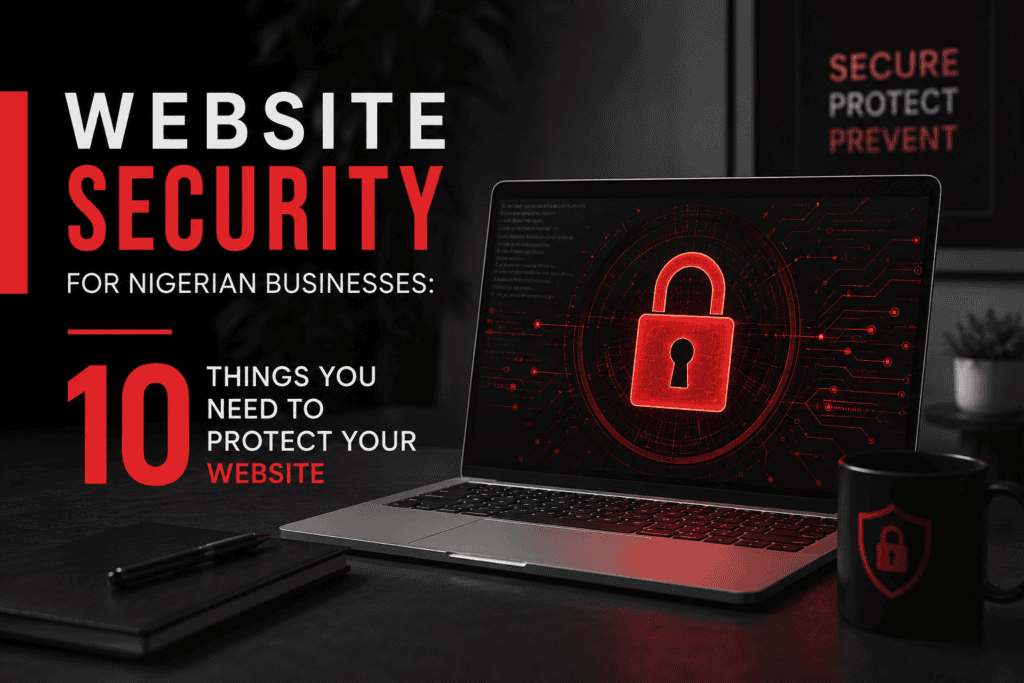
Website Security for Nigerian Businesses: 10 Things You Need to Protect Your Website
Your website is more than an online brochure. For many Nigerian businesses, it is where potential customers learn about your services, send enquiries, make purchases, book appointments, submit their information, or contact you through WhatsApp. That makes website security a business issue, not just a technical one. Imagine spending months building a professional website, getting it ranking on Google, running ads, and directing customers to it, only to discover one morning that the website has been hacked, redirected to a suspicious page, or completely taken offline. Unfortunately, website security is often something business owners think about after something goes wrong. It shouldn’t be. Whether you run a small business in Lagos, an e-commerce store, a professional service company, or a growing startup, protecting your website should be part of your digital strategy from day one. This is especially important for businesses using WordPress. WordPress itself has an active security team and regularly releases updates, but website owners still have responsibilities when it comes to plugins, themes, passwords, backups, hosting, and access control. In this guide, we’ll look at 10 practical things Nigerian businesses can do to protect their websites from common security threats. Why Website Security Matters for Nigerian Businesses A hacked website can cause much more damage than a few hours of downtime. Depending on the type of attack, your business could experience: For an e-commerce business, the consequences can be even more serious because the website may handle customer accounts, orders and other sensitive information. And there’s another issue many business owners overlook: your website is connected to your wider digital presence. If someone gains access to your website or hosting account, they may potentially interfere with email accounts, business information, files, databases or other connected services. Good security therefore isn’t about making your website impossible to attack. No website can realistically guarantee that. It’s about reducing vulnerabilities, limiting access, detecting problems early and having a reliable way to recover if something goes wrong. 10 Things You Need to Protect Your Business Website 1. Keep WordPress, Plugins and Themes Updated This is one of the simplest, and most frequently ignored, website security measures. If your website runs WordPress, you are using several pieces of software: These components can occasionally contain security vulnerabilities. Developers release updates to fix bugs, improve compatibility and address security issues. WordPress specifically recommends keeping WordPress itself, themes and plugins updated. Its documentation also recommends choosing themes and plugins that are actively maintained. What you should do Check your WordPress dashboard regularly for available updates. But don’t blindly install dozens of updates without a backup. A safer approach is: Backup → Update → Test → Monitor This is particularly important for business websites where a plugin update could affect your contact forms, WooCommerce checkout, page layouts or other functionality. If you don’t have time to maintain your website, professional website maintenance can help ensure updates and security checks don’t get forgotten. 2. Use Strong Passwords and Two-Factor Authentication Your website can have excellent hosting and security plugins, but if someone guesses your administrator password, those protections may not be enough. Avoid passwords such as: Instead, use long, unique passwords that aren’t reused across different services. And where possible, enable two-factor authentication (2FA). With 2FA, a password alone isn’t enough to access your account. An additional verification method is required. This is particularly important for: WordPress also recommends strong passwords and two-step authentication as additional protection for administrator accounts. Think of it this way: Your password is the key. 2FA is the second lock on the door. 3. Install an SSL Certificate and Use HTTPS Have you ever visited a website and seen a browser warning saying “Not Secure”? That’s a problem. Your website should use HTTPS, not plain HTTP. An SSL/TLS certificate encrypts information transferred between the visitor’s browser and your website. This is especially important for websites that collect information through contact forms, login pages, checkout pages or other forms. Google also recommends HTTPS because it improves user and site security, and browsers can flag HTTP pages as not secure. For Nigerian businesses, HTTPS is important because it: If your website still displays HTTP instead of HTTPS, speak with your hosting provider or web developer about installing and correctly configuring an SSL certificate. Don’t stop at installing the certificate, though. Your entire website should be properly configured to use HTTPS without mixed-content warnings or insecure resources. 4. Back Up Your Website Regularly Here’s a question every business owner should be able to answer: “If my website disappeared today, could I restore it?” If the answer is no, your website isn’t adequately protected. A backup gives you a way to recover your website after problems such as: A complete WordPress backup should account for both your website files and database. WordPress documentation specifically distinguishes these two components because backing up one does not necessarily mean the other has been backed up. A practical backup strategy For a business website, consider: Regular automated backups + an independent copy stored separately. And don’t simply assume that because your hosting company offers backups, you’re completely covered. You should know: Most importantly, test your backups. A backup you have never tested is not something you should blindly depend on during an emergency. 5. Be Careful With Plugins and Themes One of the biggest advantages of WordPress is its enormous ecosystem of plugins and themes. You can add almost any functionality you need. But that flexibility also creates responsibility. Installing dozens of unnecessary plugins increases the number of components that need to be maintained and secured. Even worse is downloading “premium” plugins or themes from suspicious websites simply because they’re available for free. This is commonly referred to as nulled software. A plugin that looks like a premium tool may have malicious code hidden inside it. WordPress recommends getting plugins and themes from trusted sources rather than untrusted websites. Before installing a plugin, ask: And if you aren’t using a plugin anymore, remove it instead of leaving it installed
Website Security for Nigerian Businesses: 10 Things You Need to Protect Your Website Read More »