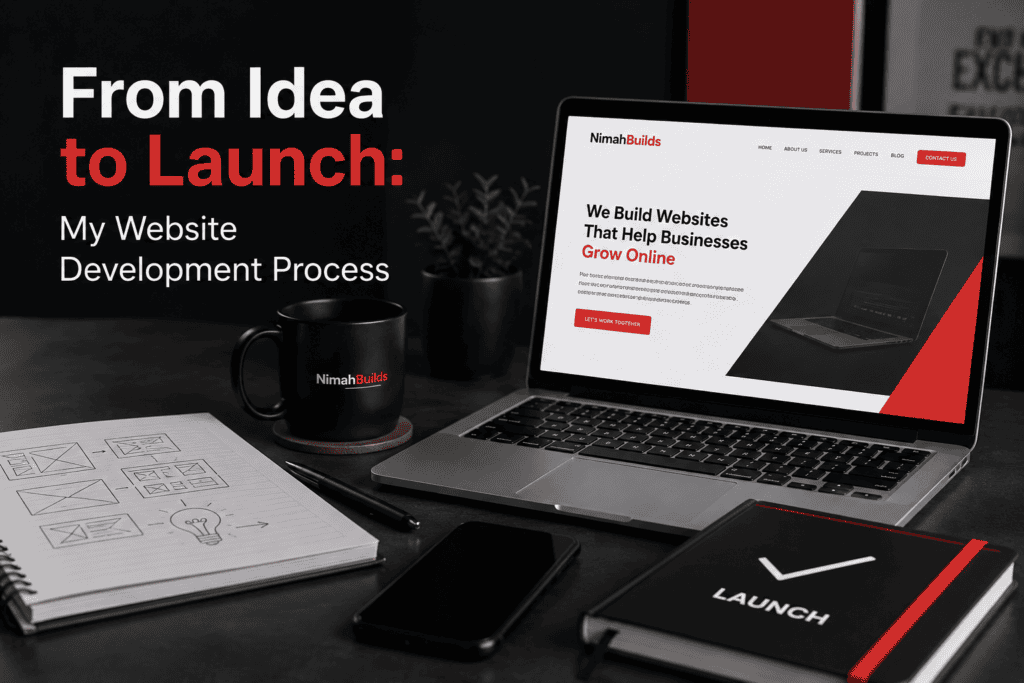
A website can start with something as simple as:
“I think my business needs a website.”
Maybe you’ve been running your business through Instagram and WhatsApp. Maybe customers keep asking for your website and you don’t have one yet. Or perhaps you already have a website, but it looks outdated, loads slowly, or simply isn’t bringing you the results you expected.
Whatever the reason, turning that initial idea into a website that actually works takes more than picking a WordPress theme and adding your logo.
At NimahBuilds, our approach to web development in Lagos starts with understanding the business behind the website.
Because before we ask, “What should the website look like?”, we ask a more important question:
“What does this website need to accomplish?”
That question influences everything that comes next.
From the structure and design to the content, SEO, performance and final launch, here’s how we take a website from an idea to a finished digital platform.
1. We Start With the Business, Not the Website
One of the easiest mistakes to make when starting a website project is jumping straight into design.
You start thinking about colours.
Then fonts.
Then animations.
Then you find a beautiful website online and decide you want yours to look exactly like it.
But none of those things answer the most important question:
What does your business actually need the website to do?
At NimahBuilds, the first stage is understanding the business, its audience and its goals.
We want to know:
- What does your business offer?
- Who are your ideal customers?
- What products or services do you provide?
- What makes your business different?
- What action should visitors take?
- Do you need enquiries, bookings, calls, WhatsApp messages or online sales?
- Do you already have a website?
- What isn’t working with your current website?
This discovery stage gives the project direction.
A website for a law firm shouldn’t be approached in exactly the same way as an e-commerce store. A restaurant doesn’t need the same user journey as a consultant. A startup may need a completely different structure from an established company.
The website should fit the business, not the other way around.
2. We Define the Website’s Structure
Once we understand what the business needs, we start planning the website structure.
Think of this as the blueprint.
Before building a house, you need to know where the rooms, doors and important spaces are going. Websites work in much the same way.
Depending on the project, a website might include:
- Home
- About
- Services
- Individual service pages
- Products
- Portfolio
- Blog
- FAQ
- Contact
- Booking pages
- Cart and checkout
The goal isn’t to create as many pages as possible.
The goal is to create the right pages.
A well-structured website makes it easier for visitors to find information and easier for search engines to understand what the business offers.
This is also where SEO starts becoming part of the project.
Instead of building a website first and thinking about search engines months later, we consider things like page structure, search intent, headings, URLs and content from the beginning.
3. We Research What Your Customers Are Searching For
A website shouldn’t only speak about your business.
It should speak about what your customers are looking for.
This is where keyword research becomes important.
For example, if you’re searching for a web development company in Lagos, you might search for:
- web development in Lagos
- website development in Lagos
- WordPress web developers in Lagos
- web design company in Lagos
- website designers in Lagos
- affordable website development in Lagos
These searches tell us something about what people want.
Keyword research helps us identify the language potential customers use when looking for products and services.
At NimahBuilds, our SEO approach focuses on keyword targeting that matches real customer searches, alongside useful content, proper page structure and technical optimisation.
This means we’re not simply trying to make a website look good.
We’re building it with visibility and discoverability in mind.
4. We Turn the Strategy Into a Design
Now we can start talking about how the website should look.
This is usually the part clients are most excited about, and understandably so.
But good web design isn’t just about making something visually attractive.
It’s about creating a visual experience that makes the website easier to understand and use.
We consider things such as:
- Brand colours
- Typography
- Images
- Layout
- Spacing
- Navigation
- Calls-to-action
- Content hierarchy
- Mobile experience
- User flow
For example, if the primary goal is to generate enquiries, the website shouldn’t make visitors hunt for the contact button.
If the goal is online sales, the buying journey needs to be straightforward.
If the goal is credibility, the website needs to communicate professionalism quickly.
Design should support the goal of the website, not distract from it.
5. Then We Build the Website
Once the structure and design are ready, development begins.
At NimahBuilds, we specialise in WordPress website development because WordPress gives businesses the flexibility to manage their content, add functionality and grow their websites over time when it’s properly configured.
Depending on the project, development may include:
- WordPress installation and configuration
- Website and page development
- Responsive layouts
- Custom sections and functionality
- Contact forms
- WhatsApp integration
- Booking functionality
- E-commerce functionality
- Payment gateway integration
- Blog setup
- Analytics integration
- Search Console setup
- SEO-ready page structure
- Security configuration
- Performance optimisation
We don’t want the website to be just another collection of pages.
The buttons need to work.
The forms need to work.
The navigation needs to make sense.
The website needs to work properly on different devices.
And if you’re selling online, the entire customer journey, from product selection to checkout, needs to be considered.
6. Mobile Comes With the Website
A website isn’t finished simply because it looks good on a laptop.
It also needs to work on a phone.
And this is especially important for businesses targeting customers in Nigeria.
People may discover your business through Google, Instagram, Facebook, WhatsApp or a shared link, and there’s a good chance they’ll visit your website from a mobile device.
That’s why responsive development is an important part of our process.
We check things such as:
- Mobile navigation
- Font sizes
- Buttons
- Images
- Forms
- Page spacing
- Columns
- Product layouts
- Calls-to-action
- Overall usability
A mobile visitor shouldn’t feel like they’re looking at a broken version of your desktop website.
The experience should feel intentional.
7. We Build With Speed in Mind
A beautiful website that takes forever to load isn’t a great website.
Speed matters because visitors don’t have unlimited patience.
If someone clicks your website and waits… and waits… and waits, there’s a good chance they’ll leave before discovering what your business offers.
That’s why performance is considered during development.
Depending on the website, optimisation can involve:
- Compressing images
- Optimising media
- Improving caching
- Reducing unnecessary scripts
- Optimising CSS and JavaScript
- Removing unnecessary plugins
- Improving hosting configuration
- Reducing page size
- Improving overall website performance
At NimahBuilds, fast-loading pages and optimised media are part of our website development approach.
The goal is simple:
Make the website feel fast, not just look fast.
8. SEO Isn’t an Afterthought
Imagine spending weeks building an impressive website, launching it, and then realising nobody can find it.
That’s one of the reasons we believe SEO should be considered during website development.
A website needs a strong foundation before you start expecting it to rank.
Our development process considers SEO fundamentals such as:
- Page titles
- Meta descriptions
- Heading structure
- Clean URLs
- Internal linking
- Image optimisation
- Keyword targeting
- Content structure
- Technical setup
- Website speed
- Mobile responsiveness
- Local SEO signals where appropriate
This doesn’t mean filling every page with the same keyword.
In fact, keyword stuffing can make content sound robotic and unpleasant to read.
Instead, the goal is to create pages that are genuinely useful while making it clear to search engines what each page is about.
For a local business, that could mean creating relevant service pages targeting specific locations and search intent.
For an online business, it might mean building content around the questions customers ask before making a purchase.
Good SEO starts with a good website foundation.
9. We Test Before We Launch
This is the stage where we stop admiring the website and start trying to break it.
Because something can look perfect and still have problems.
Before launch, we test important parts of the website, including:
Links
Are all important links working correctly?
Forms
Are enquiries actually being delivered?
Mobile responsiveness
Does the website work properly across different screen sizes?
Navigation
Can visitors easily find the information they need?
Buttons
Do calls-to-action lead visitors to the correct destination?
Images
Are images displaying correctly and optimised appropriately?
E-commerce
Can customers add products to their cart and complete the checkout process?
SEO
Are the important pages properly structured and optimised?
Performance
Are there unnecessary elements slowing the website down?
Testing isn’t glamorous.
Nobody posts on Instagram saying, “Today I tested every button on a website.”
But it’s one of the most important parts of professional web development.
10. Then Comes Launch Day
Eventually, the website is ready.
The pages have been reviewed.
The forms have been tested.
The mobile version has been checked.
The SEO foundations are in place.
The final content has been added.
The domain and hosting are configured.
And then…
We launch.
It’s an exciting moment because something that started as an idea is now a real website that customers can visit.
But here’s the thing:
Launch day isn’t the finish line.
It’s the starting line.
11. A Website Needs Care After Launch
One of the biggest misconceptions about websites is that once they’re launched, you can forget about them.
Unfortunately, websites don’t work that way.
WordPress, themes and plugins need updates.
Security needs attention.
Content becomes outdated.
Businesses introduce new services.
Products change.
Search trends change.
And customer behaviour changes.
That’s why NimahBuilds also provides website maintenance and ongoing support.
Our maintenance work can include updates, backups, security monitoring, fixing broken pages and forms, performance checks and content updates.
A website should grow alongside the business it represents.
What Makes Our Web Development Process Different?
There are many options when you’re looking for web development in Lagos.
So why does the process matter?
Because we don’t believe a website should be built simply to tick a box.
“Website? Yes, we have one.”
That’s not enough.
Your website should help answer the questions your customers are already asking.
It should communicate what you do.
It should make your business look credible.
It should make it easy for people to contact you.
It should work properly on mobile.
It should load quickly.
And it should provide a foundation for SEO and future growth.
That’s why our approach combines website development, performance, usability, SEO and ongoing maintenance rather than treating them as completely separate pieces.
How Long Does Website Development Take?
There isn’t one answer that applies to every website.
A straightforward business website can often be completed within 1–3 weeks, depending on the number of pages, content availability and project requirements.
More complex websites, particularly e-commerce websites or projects involving advanced functionality, can take 4–8 weeks or longer.
The biggest factor isn’t simply how many pages a website has.
It’s what those pages need to accomplish.
A five-page website with complex integrations can require more work than a simple ten-page informational website.
That’s why we establish the scope and requirements before development begins.
What Do We Need From You?
Building a website is a collaborative process.
You don’t need to know how to code.
You don’t need to understand WordPress.
And you definitely don’t need to become a web developer before contacting us.
What we typically need is:
- Your business information
- Details about your products or services
- Your preferred website style
- Examples of websites you like
- Your logo and branding, if available
- Existing content, if you have it
- Your goals for the website
If you don’t have everything ready, that’s okay.
We can guide you through what you need and help with content where necessary.
From an Idea to a Website That Works
Every website project starts differently.
Sometimes the client has everything planned.
Sometimes they only have a business name, a logo and a sentence that says:
“I need a website, but I don’t know where to start.”
That’s completely fine.
That’s what the process is for.
At NimahBuilds, we take that initial idea and turn it into something structured, useful and ready for the real world.
We start with the business.
Then we define the goals.
We plan the structure.
We research the audience and search intent.
We design the experience.
We build the website.
We optimise it for mobile, speed and SEO.
We test it.
We launch it.
And we remain available to help keep it running afterwards.
Because a website shouldn’t be something you build once and forget.
It should be a digital asset that continues working for your business.
Looking for Web Development in Lagos?
If you’re planning a new website, redesigning an outdated one, or simply tired of a website that doesn’t deliver what your business needs, NimahBuilds can help.
We provide professional web development in Lagos and across Nigeria, with a focus on WordPress development, performance, SEO and long-term website support. Our goal isn’t simply to give you another website.
We want to build you a website that works.
If you’re ready to turn your website idea into something real, get in touch with NimahBuilds and let’s talk about what you need.