
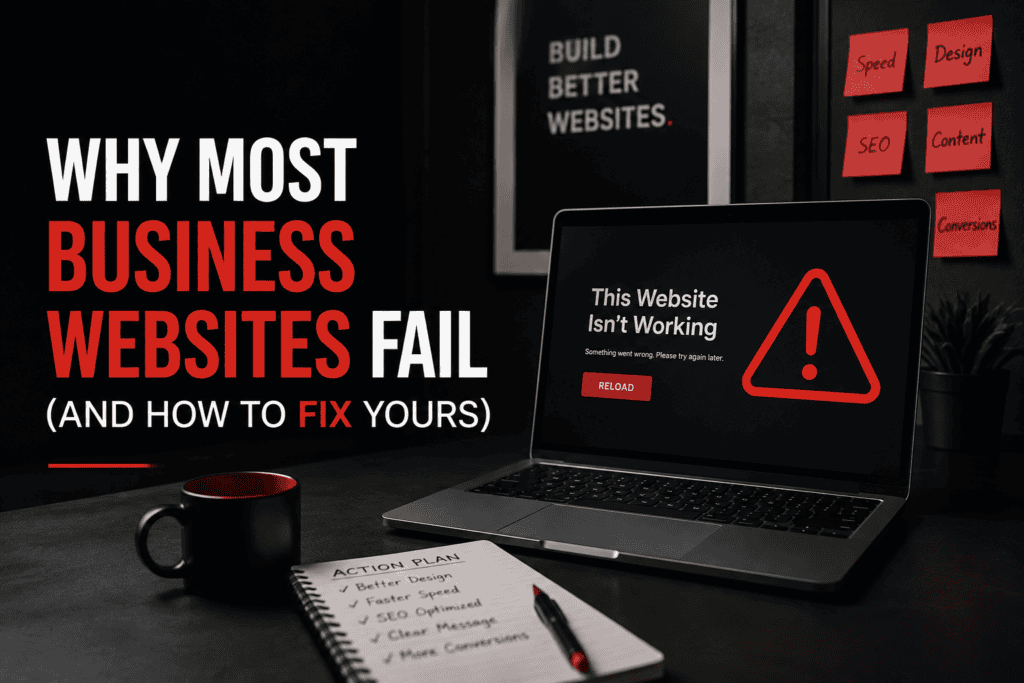
Why Most Business Websites Fail (And How to Fix Yours)
A business website can look beautiful and still fail to bring in customers. That is one of the biggest mistakes business owners make when investing in a website. They focus on how the website looks, but not enough on what the website is supposed to do. Your website should do more than display your logo, services, photos, and contact information. It should help potential customers understand what you offer, trust your business, find you on Google, and take the next step. Yet, many business websites fail at one or more of these basic jobs. The problem isn’t always bad design. Sometimes the website is too slow. Sometimes visitors don’t know what the business actually does. Sometimes the site looks great on a laptop but is frustrating to use on a phone. Other times, the website simply wasn’t built with SEO, conversions, or the customer’s journey in mind. If you’re investing in web development in Lagos, understanding these problems can save you from spending money on a website that looks impressive but produces little business value. Let’s look at why business websites fail and, more importantly, how to fix them. 1. The Website Looks Good but Doesn’t Have a Clear Purpose One of the most common website mistakes is designing pages without first defining what the website needs to accomplish. A homepage might contain beautiful animations, large images, sliders, icons, testimonials, and several sections, but after scrolling through everything, a visitor may still be wondering: “What exactly does this business do, and what am I supposed to do next?” A business website should have a clear purpose. For example, your goal might be to: Your design, content, navigation, and calls-to-action should all support that goal. How to fix it Before redesigning your website, answer three questions: Who is this website for? What problem does the business solve? What action should visitors take? Once these are clear, the website becomes much easier to structure. Good web development isn’t simply about putting elements on a page. It’s about creating a digital experience with a purpose. 2. The Website Is Built for the Business Owner, Not the Customer This happens more often than you might think. Business owners naturally want to talk about themselves. They want to explain their history, achievements, services, certifications, and everything they have worked hard to accomplish. That’s understandable. But your customer is usually thinking about something else: “Can you solve my problem?” A strong website should connect your services to your customer’s needs. Instead of simply saying: “We provide professional digital marketing services.” You could communicate the actual benefit: “Get more qualified customers from Google with SEO designed around your business goals.” The second statement immediately gives the visitor a reason to keep reading. How to fix it Review every major section of your website and ask: “Why should my customer care about this?” If a section doesn’t answer a question, solve a problem, build trust, or move the visitor toward taking action, consider removing or rewriting it. 3. Visitors Don’t Know What to Do Next Imagine someone visits your website and is interested in your service. They want to contact you. But there is no obvious button. Or the contact information is buried at the bottom of the page. Or the only button says “Learn More” even though the visitor is already ready to buy. That’s a conversion problem. Your website should make the next step obvious. Depending on your business, your calls-to-action could include: How to fix it Use clear calls-to-action throughout your website. Don’t make visitors hunt for the next step. A good CTA should tell people exactly what happens when they click it. 4. The Website Is Too Slow People are impatient online. If your website takes too long to load, visitors may leave before they even see what you offer. A slow website can also create a poor experience for people browsing on mobile devices or slower connections. Google also recommends paying attention to page experience and Core Web Vitals as part of creating a good experience for users. Common causes of slow websites include: How to fix it Start with the basics: Compress your images. Use modern image formats where appropriate. Remove unnecessary plugins and scripts. Optimize your website’s code and assets. Use reliable hosting and caching. Test your website on mobile, not just your computer. Speed optimization isn’t about chasing a perfect score just for the sake of SEO. The goal is to create a website that feels fast and easy to use. 5. The Website Doesn’t Work Properly on Mobile This is a major problem. Your website might look perfect on a desktop screen and completely fall apart on a smartphone. Text may be too small. Buttons may be difficult to tap. Sections may overflow horizontally. Images may cover important content. Forms may be frustrating to complete. And because many potential customers browse businesses from their phones, this can cost you real enquiries and sales. Google’s current guidance also emphasizes that pages should display well on mobile devices as part of providing a good page experience. How to fix it Don’t treat mobile responsiveness as an afterthought. During the web development process, test important pages across different screen sizes. Pay particular attention to: Your website should be easy to use whether someone visits from a laptop, tablet, or smartphone. 6. There Is Little or No SEO You can have the best website in your industry and still struggle to attract customers if nobody can find it. This is where SEO becomes important. Search engine optimization helps search engines understand your website and helps potential customers discover your business when searching for relevant services. For example, a Lagos business providing website services may want to appear for searches related to: web development in Lagos But simply putting that keyword everywhere isn’t SEO. Google recommends creating helpful, reliable, people-first content and using words that people actually search for in relevant parts of your content. How to fix it Your website should have
Why Most Business Websites Fail (And How to Fix Yours) Read More »