
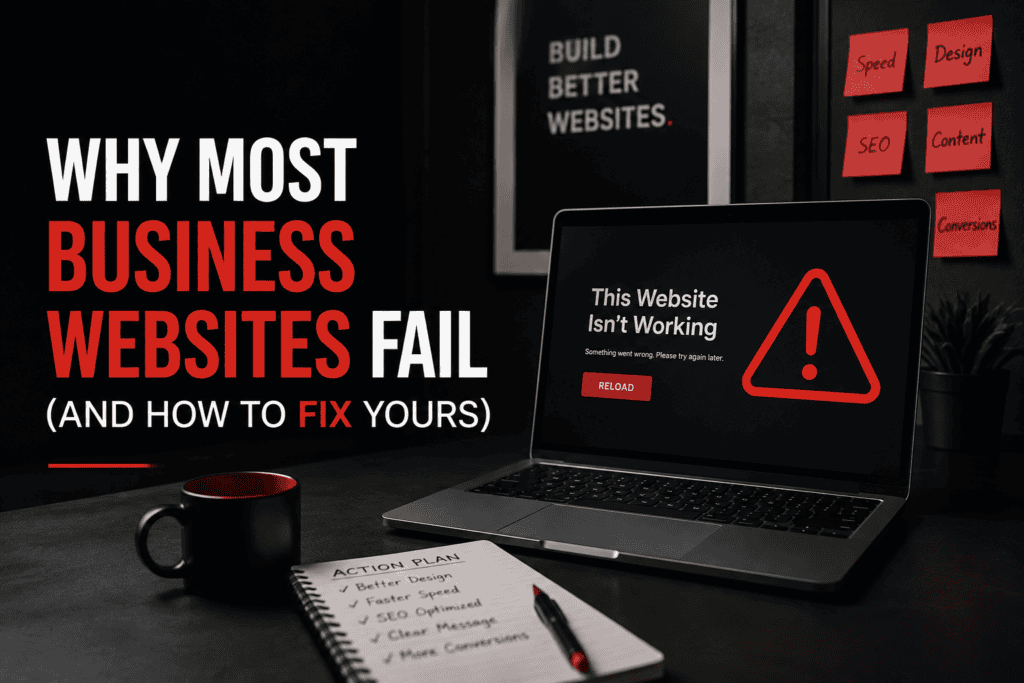
A business website can look beautiful and still fail to bring in customers.
That is one of the biggest mistakes business owners make when investing in a website. They focus on how the website looks, but not enough on what the website is supposed to do.
Your website should do more than display your logo, services, photos, and contact information. It should help potential customers understand what you offer, trust your business, find you on Google, and take the next step.
Yet, many business websites fail at one or more of these basic jobs.
The problem isn’t always bad design. Sometimes the website is too slow. Sometimes visitors don’t know what the business actually does. Sometimes the site looks great on a laptop but is frustrating to use on a phone. Other times, the website simply wasn’t built with SEO, conversions, or the customer’s journey in mind.
If you’re investing in web development in Lagos, understanding these problems can save you from spending money on a website that looks impressive but produces little business value.
Let’s look at why business websites fail and, more importantly, how to fix them.
1. The Website Looks Good but Doesn’t Have a Clear Purpose
One of the most common website mistakes is designing pages without first defining what the website needs to accomplish.
A homepage might contain beautiful animations, large images, sliders, icons, testimonials, and several sections, but after scrolling through everything, a visitor may still be wondering:
“What exactly does this business do, and what am I supposed to do next?”
A business website should have a clear purpose.
For example, your goal might be to:
- Generate enquiries
- Get customers to call or send a WhatsApp message
- Sell products online
- Generate bookings
- Build credibility
- Get visitors to request a quotation
- Generate leads through a contact form
Your design, content, navigation, and calls-to-action should all support that goal.
How to fix it
Before redesigning your website, answer three questions:
Who is this website for?
What problem does the business solve?
What action should visitors take?
Once these are clear, the website becomes much easier to structure.
Good web development isn’t simply about putting elements on a page. It’s about creating a digital experience with a purpose.
2. The Website Is Built for the Business Owner, Not the Customer
This happens more often than you might think.
Business owners naturally want to talk about themselves. They want to explain their history, achievements, services, certifications, and everything they have worked hard to accomplish.
That’s understandable.
But your customer is usually thinking about something else:
“Can you solve my problem?”
A strong website should connect your services to your customer’s needs.
Instead of simply saying:
“We provide professional digital marketing services.”
You could communicate the actual benefit:
“Get more qualified customers from Google with SEO designed around your business goals.”
The second statement immediately gives the visitor a reason to keep reading.
How to fix it
Review every major section of your website and ask:
“Why should my customer care about this?”
If a section doesn’t answer a question, solve a problem, build trust, or move the visitor toward taking action, consider removing or rewriting it.
3. Visitors Don’t Know What to Do Next
Imagine someone visits your website and is interested in your service.
They want to contact you.
But there is no obvious button.
Or the contact information is buried at the bottom of the page.
Or the only button says “Learn More” even though the visitor is already ready to buy.
That’s a conversion problem.
Your website should make the next step obvious.
Depending on your business, your calls-to-action could include:
- Get a Quote
- Book a Consultation
- Request a Callback
- Shop Now
- Send Us a WhatsApp Message
- Schedule an Appointment
- Get Started
- Contact Us
How to fix it
Use clear calls-to-action throughout your website.
Don’t make visitors hunt for the next step.
A good CTA should tell people exactly what happens when they click it.
4. The Website Is Too Slow
People are impatient online.
If your website takes too long to load, visitors may leave before they even see what you offer.
A slow website can also create a poor experience for people browsing on mobile devices or slower connections.
Google also recommends paying attention to page experience and Core Web Vitals as part of creating a good experience for users.
Common causes of slow websites include:
- Huge image files
- Poorly optimized videos
- Too many plugins
- Bloated themes
- Excessive animations
- Unoptimized code
- Poor hosting configuration
- Too many third-party scripts
How to fix it
Start with the basics:
Compress your images.
Use modern image formats where appropriate.
Remove unnecessary plugins and scripts.
Optimize your website’s code and assets.
Use reliable hosting and caching.
Test your website on mobile, not just your computer.
Speed optimization isn’t about chasing a perfect score just for the sake of SEO. The goal is to create a website that feels fast and easy to use.
5. The Website Doesn’t Work Properly on Mobile
This is a major problem.
Your website might look perfect on a desktop screen and completely fall apart on a smartphone.
Text may be too small. Buttons may be difficult to tap. Sections may overflow horizontally. Images may cover important content. Forms may be frustrating to complete.
And because many potential customers browse businesses from their phones, this can cost you real enquiries and sales.
Google’s current guidance also emphasizes that pages should display well on mobile devices as part of providing a good page experience.
How to fix it
Don’t treat mobile responsiveness as an afterthought.
During the web development process, test important pages across different screen sizes.
Pay particular attention to:
- Navigation
- Buttons
- Contact forms
- Font sizes
- Images
- Product pages
- Pricing sections
- WhatsApp and phone links
- Checkout processes
Your website should be easy to use whether someone visits from a laptop, tablet, or smartphone.
6. There Is Little or No SEO
You can have the best website in your industry and still struggle to attract customers if nobody can find it.
This is where SEO becomes important.
Search engine optimization helps search engines understand your website and helps potential customers discover your business when searching for relevant services.
For example, a Lagos business providing website services may want to appear for searches related to:
web development in Lagos
But simply putting that keyword everywhere isn’t SEO.
Google recommends creating helpful, reliable, people-first content and using words that people actually search for in relevant parts of your content.
How to fix it
Your website should have a proper SEO foundation, including:
- Keyword research
- Optimized page titles
- Meta descriptions
- Clear H1 and H2 headings
- Search-friendly URLs
- Internal linking
- Image alt text
- Useful service pages
- Location-specific content where relevant
- Technical SEO
- Fast-loading pages
- Google Search Console setup
- Quality, useful content
SEO should be considered during website development, not months after the website has already been launched.
7. The Content Is Generic
Another reason websites fail is because the content sounds exactly like everyone else’s.
You’ve probably seen phrases like:
“We are committed to delivering excellence.”
“Our team of professionals provides high-quality solutions.”
“We put our customers first.”
There is nothing inherently wrong with these statements, but they don’t tell your customer much.
Your website content should sound like your business and speak directly to the people you want to serve.
How to fix it
Be specific.
Instead of:
“We offer high-quality web design services.”
Try:
“We build fast, responsive WordPress websites for businesses that want to look professional and generate more enquiries online.”
Specificity creates clarity.
And clarity builds trust.
8. There Is No Trust
Think about what happens when someone discovers your business for the first time.
They don’t know you.
They don’t know whether you’re legitimate.
They don’t know whether you’ll deliver.
Your website needs to answer those concerns.
Trust can come from:
- Client testimonials
- Case studies
- Portfolio projects
- Reviews
- Business information
- Professional photographs
- Clear contact information
- Guarantees where appropriate
- Transparent service descriptions
- Helpful educational content
Your website doesn’t need to brag.
It needs to give people enough evidence to feel comfortable taking the next step.
9. The Navigation Is Confusing
A website shouldn’t feel like a maze.
If someone has to click through five different pages just to find your services or contact details, something needs to change.
Your navigation should make sense to someone who has never visited your website before.
For many businesses, a simple structure works well:
Home → About → Services → Portfolio/Projects → Blog → Contact
Depending on the business, you may also need:
Shop → Individual Product Pages → Cart → Checkout
How to fix it
Keep your primary navigation simple.
Use familiar labels.
Make important pages easy to reach.
And don’t hide your contact information.
A good website quietly guides people from “Who are you?” to “I trust you” to “Let’s work together.”
10. The Website Has No Conversion Strategy
Traffic is not the same thing as business.
You could get hundreds or thousands of visitors and still receive very few enquiries.
Why?
Because the website isn’t designed to convert visitors into leads or customers.
Conversion-focused web development considers what happens after someone lands on the website.
For example:
Google Search → Service Page → Trust Signals → Clear CTA → Contact Form → Follow-Up
Every stage matters.
How to fix it
Look at your important pages and ask:
Does this page answer the visitor’s question?
Does it explain the value of the service?
Does it address objections?
Does it provide evidence or trust signals?
Is there a clear next step?
If the answer is no, your website probably needs more than a visual redesign.
It needs a conversion strategy.
11. The Website Was Built Once and Forgotten
This is another major mistake.
A website isn’t a billboard that you build once and never touch again.
Technology changes.
Customer expectations change.
Search algorithms evolve.
Businesses add new services.
Old information becomes inaccurate.
Security vulnerabilities emerge.
Plugins and software require updates.
Your website should therefore be treated as an ongoing business asset.
How to fix it
Create a simple website maintenance routine.
Regularly check:
- Software and plugin updates
- Website security
- Broken links
- Contact forms
- Website speed
- Mobile responsiveness
- Analytics
- Search performance
- Backups
- Outdated content
A website that worked perfectly two years ago may need significant improvements today.
So, How Do You Fix a Failing Business Website?
You don’t necessarily need to throw everything away and start again.
Sometimes the problem is your content.
Sometimes it’s SEO.
Sometimes it’s speed.
Sometimes it’s the user experience.
And sometimes the entire website needs to be rebuilt.
Start with a proper audit.
Step 1: Identify the Biggest Problems
Look at your website objectively.
Check your:
- Design
- Content
- Speed
- Mobile experience
- SEO
- Navigation
- Calls-to-action
- Trust signals
- Conversion process
- Technical setup
Don’t redesign everything simply because you don’t like the color of a button.
Fix the problems that affect your customers and business results first.
Step 2: Understand Your Customer
Your website should be built around the people you want to attract.
Understand:
- What they are looking for
- What problems they have
- What questions they ask
- What objections they have
- What makes them trust a business
- What action you want them to take
This information should influence your design and content.
Step 3: Build a Strong SEO Foundation
SEO should be part of your website structure from the beginning.
Research the terms your potential customers use.
Create useful pages around relevant topics.
Optimize your headings, titles, URLs, images, internal links, and content.
Most importantly, don’t write for search engines at the expense of your customers. Google explicitly recommends a people-first approach rather than creating content primarily to manipulate rankings.
Step 4: Make the Website Fast and Mobile-Friendly
Optimize images.
Reduce unnecessary scripts.
Use appropriate caching.
Improve your hosting setup.
Check Core Web Vitals.
Test the actual user experience on mobile devices.
A technically impressive website means very little if customers struggle to use it.
Step 5: Give Visitors a Clear Next Step
Don’t assume visitors will figure it out themselves.
Tell them what to do.
Need a website? → Get a Quote.
Have questions? → Contact Us.
Ready to buy? → Shop Now.
Want to discuss your project? → Book a Consultation.
Simple can be powerful.
What Good Web Development Should Actually Look Like
Good web development in Lagos isn’t just about creating a website that looks modern.
It’s about creating a website that works for the business behind it.
That means combining:
Design + Strategy + SEO + Performance + User Experience + Conversion
When these pieces work together, your website becomes more than an online brochure.
It becomes a business tool.
A good website should help you establish credibility, communicate your value, attract the right visitors, and turn those visitors into enquiries, customers, or repeat buyers.
That’s the difference between having a website and having a website that actually works.
Your Website Doesn’t Need to Be Perfect. It Needs to Be Useful.
One of the biggest misconceptions about websites is that success comes from making them look expensive.
It doesn’t.
A beautiful website with confusing navigation won’t convert well.
A modern website with poor SEO won’t get enough organic visibility.
A feature-packed website that loads slowly will frustrate users.
And a website with great traffic but no clear calls-to-action may generate very little revenue.
The goal isn’t to build the fanciest website possible.
The goal is to build the right website for your customers and your business.
If your current website isn’t generating the results you expected, don’t immediately assume that you need more traffic.
You may need a better foundation.
Need Better Web Development in Lagos?
At NimahBuilds, we help businesses create professional websites that are designed around clarity, performance, SEO, and real business goals.
Whether you’re starting from scratch or your existing website needs a complete overhaul, the right approach begins with understanding what your business needs, and what your customers expect.
Your website should represent your business professionally, make it easy for people to find you, and give potential customers a clear reason to take action.
If your current website isn’t doing that, it’s probably time to fix it.
Ready to build a website that works for your business?
Contact NimahBuilds to discuss your website development project.
Frequently Asked Questions
Why do most business websites fail?
Most business websites fail because they are built without a clear strategy. Common problems include poor user experience, slow loading speeds, weak SEO, confusing navigation, generic content, poor mobile responsiveness, and unclear calls-to-action.
How can I tell if my website is failing?
Look at your website’s actual results. If you’re getting visitors but very few enquiries or sales, your website may have a conversion problem. If you’re barely receiving organic traffic, SEO may be an issue. High bounce rates, slow pages, poor mobile usability, and outdated content can also indicate problems.
Is SEO important when building a business website?
Yes. SEO should be considered during the website development process rather than treated as an afterthought. A strong SEO foundation helps search engines understand your pages and helps potential customers discover your business.
How important is mobile responsiveness?
Extremely important. A significant portion of website browsing happens on mobile devices, so your website needs to be easy to navigate, read, and interact with on smaller screens.
How often should a business website be updated?
There isn’t one universal schedule. However, websites should be regularly checked for security, software updates, broken links, outdated content, performance problems, and changes in business information.
Final Thoughts
Your website is often the first serious interaction someone has with your business.
If that experience is confusing, slow, outdated, or difficult to use, you may lose the customer before you ever get the opportunity to speak with them.
The good news is that most website problems can be identified and fixed.
Start with the fundamentals:
Clear messaging.
Useful content.
Strong SEO.
Fast performance.
Mobile-friendly design.
Simple navigation.
Trust-building elements.
Clear calls-to-action.
Get those right, and your website can become one of the most valuable assets your business has online.
And if you’re considering web development in Lagos, don’t just ask whether a web designer can make your website look good.
Ask whether they can build a website that works.