February 2026

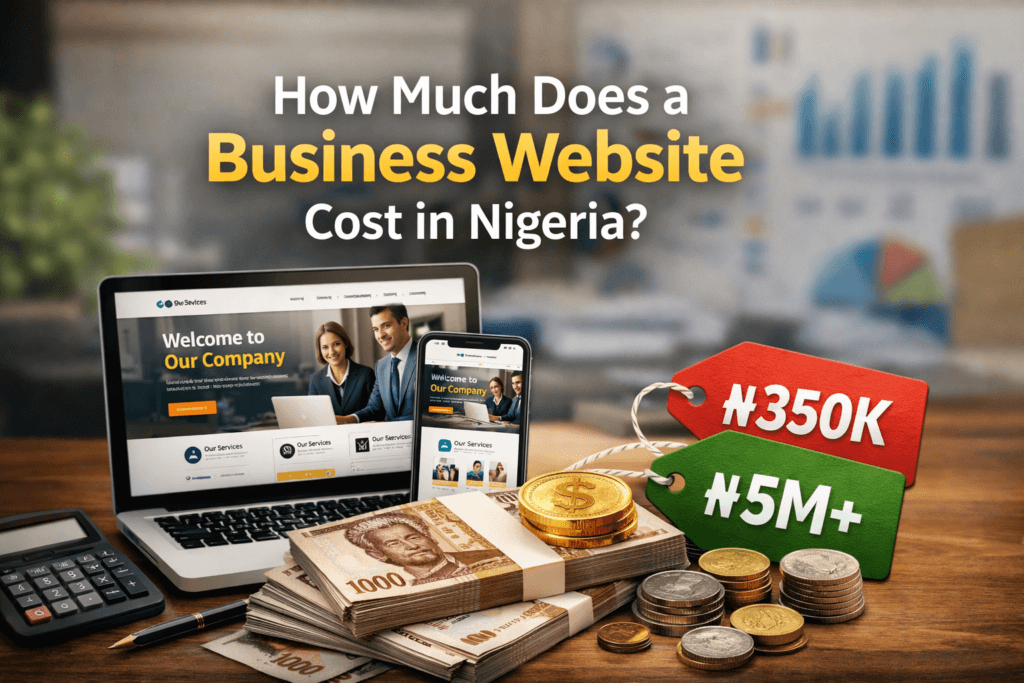
How Much Does a Business Website Cost in Nigeria?

How much does a business website cost in Nigeria? This is a question many business owners ask when looking to build a website and start getting real online results. Many business owners in Nigeria struggle to understand how much a website actually costs. Prices vary widely, and it can be confusing to know what you’re really paying for. In this article, we’ll break down what affects website pricing and what you should expect to pay. Based on our experience building websites for Nigerian businesses, here’s what most clients actually spend: The cost of building a website in Nigeria varies from one web designer to another. It also depends on several major factors: There are some major costs to consider when trying to build a website. These include: Domain name, Hosting/server, SSL security, content writing, domain privacy (optional) and more. The table below shows the breakdown of the cost of building a website in Nigeria: S/N Website Feature Cost 1 Domain Name .com/.net/.org ₦30,000 annually .ng ₦15,000 – ₦20,000 annually Backorder domains (Branded, premium domain names) ₦100,000 to ₦120,000 for first year 2 Web Hosting / Server Shared hosting ₦95,000 – ₦250,000 Cloud/Virtual Private Server (VPS) ₦540,000 – ₦2.5 million annually Dedicated Servers ₦2.5 million – 6.5 million annually 3 SSL Certificate SSL  ₦45,000 – ₦1.5 million  4 Templates WordPress/Shopify/Joomla Theme ₦100,000 – ₦400,000 5 Domain Privacy Annually ₦15,000 – ₦20,000 6 Web Developer’s Fee Up to 5 pages ₦100,000 – 400,000 More than 5 pages ₦400,000 – ₦700,000 Ecommerce websites (depending on number of products) ₦700,000 and above The cost of web hosting depends on the type of hosting you choose, and that choice depends largely on the size and purpose of your website. In our experience working with Nigerian SMEs, hosting can range from as low as ₦95,000 to as high as ₦6.5 million annually. We’ve heard many business owners say, “But we heard there are free hosting platforms online.” Our usual response is simple: free hosting is rarely a good idea for serious businesses and cheap websites often end up costing more in the long run. 3. SSL Certificate: An SSL certificate is a digital security file installed on a website server that enables encrypted, secure communication (HTTPS) between a user’s browser and the site. It protects sensitive data like passwords and credit cards from theft, establishes trust via a browser padlock icon, and improves SEO rankings. Without a trusted SSL certificate, Web browsers like Chrome will mark the site as “Not Secure,” causing visitors to leave. An SSL certificate costs about 45,000 to 1.5 million naira annually, depending on the type of SSL certificate you purchase and how secure you want your website to be. A very secure ssl certificate is usually required by websites that deal with sensitive information like credit card information, passwords, etc. 4. Domain Privacy: When you register a domain, ICANN (the governing body for domain names) requires that your name, address, email, and phone number be listed in a public directory called WHOIS. Registering a domain without privacy is like publishing your home address, cell phone number, and personal email in a newspaper listing that anyone in the world can search. Domain privacy hides your personal address and name, making it much harder for someone to impersonate you.  5. Web Developer’s Fee:  Fees range from one web developer to the other, depending on years of experience, skill level and expertise. Some web developers charge as low as 100,000 naira for a standard business website in Nigeria, while others may charge as much as 3 – 5 million naira. 6. WordPress/Joomla/Shopify Templates: WordPress, Joomla, and Shopify are versatile website-building platforms. A theme is a pre-designed layout that can be customized using plugins to achieve different functionalities, from a simple blog to a complex business website. Theme prices vary depending on the platform and level of functionality. In Nigeria, they typically range from ₦100,000 to ₦400,000. However, it is not compulsory to purchase a premium theme to build a professional website. We’ve seen businesses overspend on themes that were not necessary for their needs. Premium themes are often recommended because they are time-saving, functional, responsive, and cost-effective compared to fully custom design. That said, templates do have structural limitations. They work perfectly for most business websites, but if you require very unique or highly customized functionality, custom development may be needed later. Before hiring a web designer, make sure you: In conclusion, the cost of building a standard business website in Nigeria typically starts from around ₦350,000 and can go as high as ₦5 million or more, depending on your needs, features, and long-term goals. The most important thing is not just the price, but understanding what you are paying for. When you’re clear about the scope, functionality, and ongoing costs, you avoid unnecessary expenses and costly mistakes. If you’re planning to build a website for your business and need a clear, honest breakdown of how much does a business website cost in Nigeria and expectations, you can contact NimahBuilds for proper guidance.

How Much Does a Business Website Cost in Nigeria? Read More »
web development in Lagos

From Idea to Launch: My Website Development Process

A website can start with something as simple as: “I think my business needs a website.” Maybe you’ve been running your business through Instagram and WhatsApp. Maybe customers keep asking for your website and you don’t have one yet. Or perhaps you already have a website, but it looks outdated, loads slowly, or simply isn’t bringing you the results you expected. Whatever the reason, turning that initial idea into a website that actually works takes more than picking a WordPress theme and adding your logo. At NimahBuilds, our approach to web development in Lagos starts with understanding the business behind the website. Because before we ask, “What should the website look like?”, we ask a more important question: “What does this website need to accomplish?” That question influences everything that comes next. From the structure and design to the content, SEO, performance and final launch, here’s how we take a website from an idea to a finished digital platform. 1. We Start With the Business, Not the Website One of the easiest mistakes to make when starting a website project is jumping straight into design. You start thinking about colours. Then fonts. Then animations. Then you find a beautiful website online and decide you want yours to look exactly like it. But none of those things answer the most important question: What does your business actually need the website to do? At NimahBuilds, the first stage is understanding the business, its audience and its goals. We want to know: This discovery stage gives the project direction. A website for a law firm shouldn’t be approached in exactly the same way as an e-commerce store. A restaurant doesn’t need the same user journey as a consultant. A startup may need a completely different structure from an established company. The website should fit the business, not the other way around. 2. We Define the Website’s Structure Once we understand what the business needs, we start planning the website structure. Think of this as the blueprint. Before building a house, you need to know where the rooms, doors and important spaces are going. Websites work in much the same way. Depending on the project, a website might include: The goal isn’t to create as many pages as possible. The goal is to create the right pages. A well-structured website makes it easier for visitors to find information and easier for search engines to understand what the business offers. This is also where SEO starts becoming part of the project. Instead of building a website first and thinking about search engines months later, we consider things like page structure, search intent, headings, URLs and content from the beginning. 3. We Research What Your Customers Are Searching For A website shouldn’t only speak about your business. It should speak about what your customers are looking for. This is where keyword research becomes important. For example, if you’re searching for a web development company in Lagos, you might search for: These searches tell us something about what people want. Keyword research helps us identify the language potential customers use when looking for products and services. At NimahBuilds, our SEO approach focuses on keyword targeting that matches real customer searches, alongside useful content, proper page structure and technical optimisation. This means we’re not simply trying to make a website look good. We’re building it with visibility and discoverability in mind. 4. We Turn the Strategy Into a Design Now we can start talking about how the website should look. This is usually the part clients are most excited about, and understandably so. But good web design isn’t just about making something visually attractive. It’s about creating a visual experience that makes the website easier to understand and use. We consider things such as: For example, if the primary goal is to generate enquiries, the website shouldn’t make visitors hunt for the contact button. If the goal is online sales, the buying journey needs to be straightforward. If the goal is credibility, the website needs to communicate professionalism quickly. Design should support the goal of the website, not distract from it. 5. Then We Build the Website Once the structure and design are ready, development begins. At NimahBuilds, we specialise in WordPress website development because WordPress gives businesses the flexibility to manage their content, add functionality and grow their websites over time when it’s properly configured. Depending on the project, development may include: We don’t want the website to be just another collection of pages. The buttons need to work. The forms need to work. The navigation needs to make sense. The website needs to work properly on different devices. And if you’re selling online, the entire customer journey, from product selection to checkout, needs to be considered. 6. Mobile Comes With the Website A website isn’t finished simply because it looks good on a laptop. It also needs to work on a phone. And this is especially important for businesses targeting customers in Nigeria. People may discover your business through Google, Instagram, Facebook, WhatsApp or a shared link, and there’s a good chance they’ll visit your website from a mobile device. That’s why responsive development is an important part of our process. We check things such as: A mobile visitor shouldn’t feel like they’re looking at a broken version of your desktop website. The experience should feel intentional. 7. We Build With Speed in Mind A beautiful website that takes forever to load isn’t a great website. Speed matters because visitors don’t have unlimited patience. If someone clicks your website and waits… and waits… and waits, there’s a good chance they’ll leave before discovering what your business offers. That’s why performance is considered during development. Depending on the website, optimisation can involve: At NimahBuilds, fast-loading pages and optimised media are part of our website development approach. The goal is simple: Make the website feel fast, not just look fast. 8. SEO Isn’t an Afterthought Imagine spending weeks building an impressive website, launching it, and then realising

From Idea to Launch: My Website Development Process Read More »

web development in Lagos

The Power of Clean UI in Building Brand Trust

A clean website is more than something that looks good. It can influence how people perceive your business, how comfortable they feel using your website, and ultimately, whether they trust your brand enough to take the next step. Think about the last time you visited a website for the first time. Maybe you were looking for a service, checking out a business, or considering buying something online. Within a few seconds, you probably had a feeling about the brand. “This business looks professional.” Or perhaps: “Something about this website doesn’t feel right.” You may not have been able to explain exactly why you felt that way, but the design played a major role. That is the power of a clean user interface (UI). In today’s digital-first business environment, your website is often one of the first interactions a potential customer has with your brand. And when that first interaction is confusing, cluttered, outdated, or difficult to use, it can damage trust before you even get the opportunity to explain what your business does. For businesses investing in web development in Lagos, clean UI should therefore be treated as more than a design trend. It should be part of the strategy for building credibility, communicating professionalism, and creating an online experience that customers feel confident using. What Does “Clean UI” Actually Mean? Clean UI does not necessarily mean having a completely minimalist website with lots of empty space and almost no visual elements. Instead, clean UI means that every element on a website has a purpose. The navigation is easy to understand. The typography is readable. The colours work together. The buttons are obvious. The content is properly organised. Images are relevant and high-quality. There is enough whitespace to prevent the page from feeling crowded. Most importantly, visitors don’t have to work hard to figure out what to do next. A clean interface quietly guides users through the website without constantly demanding their attention. And that simplicity matters. When people can easily understand your website, they are more likely to feel that your business is organised, professional, and reliable. Why Does Website Design Affect Brand Trust? Trust is not built only through testimonials, reviews, certifications, or years of experience. It is also built through small signals. Your website’s design is one of those signals. Recent research into website credibility continues to show that design and layout are among the first things people notice when evaluating a website. Clutch’s 2025 research, for example, found that design and layout were the leading factor users noticed when visiting a website for the first time. That makes sense. Imagine walking into a physical business. The reception area is organised. The signs are clear. Everything looks clean and well maintained. The staff know what they are doing. You naturally feel more comfortable. Now imagine walking into another business where everything is disorganised, signs are confusing, information is difficult to find, and nothing looks properly maintained. Even if both businesses offer exactly the same service, you are probably going to trust the first one more. Your website works in much the same way. Good UI creates digital confidence. 7 Ways Clean UI Builds Brand Trust 1. It Creates a Strong First Impression Your website doesn’t get unlimited time to convince visitors that your business is credible. People make quick judgments when they land on a new website. A professional interface immediately communicates attention to detail. This doesn’t mean your website needs expensive animations or complicated effects. In fact, adding too many visual effects can have the opposite effect. A strong first impression can come from simple things: These details might seem small individually, but together they create the overall impression of your brand. 2. It Makes Your Business Look More Professional Your website is an extension of your brand. If your business claims to offer premium services but its website looks outdated, inconsistent, or poorly organised, there is a disconnect. Customers may start asking themselves: “If they don’t pay attention to their website, will they pay attention to my project?” Clean UI helps eliminate that doubt. A consistent visual system, including colours, fonts, buttons, spacing, imagery, and layouts, makes your business feel intentional. It tells visitors that you care about the details. And attention to detail is a powerful trust signal. 3. It Makes Information Easier to Understand One of the biggest mistakes businesses make is trying to put everything on one page. More information doesn’t automatically mean more value. Sometimes, it simply creates more confusion. A clean UI uses visual hierarchy to help visitors understand what matters first. For example, a service page might present information in this order: What you offer → Who it’s for → Benefits → How it works → Proof → Call to action Instead of throwing ten paragraphs, five buttons, three banners, and multiple unrelated sections at the visitor, the interface gives them a logical path to follow. This is particularly important for service businesses. If a potential client cannot quickly understand what you offer, who you serve, and how to contact you, your website is creating unnecessary friction. 4. It Reduces User Frustration A beautiful website that is difficult to use is still a bad website. Clean UI is closely connected to usability. Visitors should be able to answer basic questions without having to hunt around your website: Good UI makes those answers easy to find. For example, your contact button shouldn’t be hidden at the bottom of a long page. Your navigation shouldn’t contain twenty confusing menu items. Your forms shouldn’t ask for unnecessary information. Every unnecessary step creates friction. And friction can cost you customers. 5. It Makes Your Brand More Consistent Imagine seeing a company’s Instagram page with a sophisticated visual identity, then clicking through to a website that uses completely different colours, fonts, images, and messaging. It feels disconnected. Brand consistency helps people recognise and remember your business. Your website should feel like the same brand customers encounter on Instagram, Facebook, LinkedIn, Google, or anywhere

The Power of Clean UI in Building Brand Trust Read More »

web development in Lagos

Why Most Business Websites Fail (And How to Fix Yours)

A business website can look beautiful and still fail to bring in customers. That is one of the biggest mistakes business owners make when investing in a website. They focus on how the website looks, but not enough on what the website is supposed to do. Your website should do more than display your logo, services, photos, and contact information. It should help potential customers understand what you offer, trust your business, find you on Google, and take the next step. Yet, many business websites fail at one or more of these basic jobs. The problem isn’t always bad design. Sometimes the website is too slow. Sometimes visitors don’t know what the business actually does. Sometimes the site looks great on a laptop but is frustrating to use on a phone. Other times, the website simply wasn’t built with SEO, conversions, or the customer’s journey in mind. If you’re investing in web development in Lagos, understanding these problems can save you from spending money on a website that looks impressive but produces little business value. Let’s look at why business websites fail and, more importantly, how to fix them. 1. The Website Looks Good but Doesn’t Have a Clear Purpose One of the most common website mistakes is designing pages without first defining what the website needs to accomplish. A homepage might contain beautiful animations, large images, sliders, icons, testimonials, and several sections, but after scrolling through everything, a visitor may still be wondering: “What exactly does this business do, and what am I supposed to do next?” A business website should have a clear purpose. For example, your goal might be to: Your design, content, navigation, and calls-to-action should all support that goal. How to fix it Before redesigning your website, answer three questions: Who is this website for? What problem does the business solve? What action should visitors take? Once these are clear, the website becomes much easier to structure. Good web development isn’t simply about putting elements on a page. It’s about creating a digital experience with a purpose. 2. The Website Is Built for the Business Owner, Not the Customer This happens more often than you might think. Business owners naturally want to talk about themselves. They want to explain their history, achievements, services, certifications, and everything they have worked hard to accomplish. That’s understandable. But your customer is usually thinking about something else: “Can you solve my problem?” A strong website should connect your services to your customer’s needs. Instead of simply saying: “We provide professional digital marketing services.” You could communicate the actual benefit: “Get more qualified customers from Google with SEO designed around your business goals.” The second statement immediately gives the visitor a reason to keep reading. How to fix it Review every major section of your website and ask: “Why should my customer care about this?” If a section doesn’t answer a question, solve a problem, build trust, or move the visitor toward taking action, consider removing or rewriting it. 3. Visitors Don’t Know What to Do Next Imagine someone visits your website and is interested in your service. They want to contact you. But there is no obvious button. Or the contact information is buried at the bottom of the page. Or the only button says “Learn More” even though the visitor is already ready to buy. That’s a conversion problem. Your website should make the next step obvious. Depending on your business, your calls-to-action could include: How to fix it Use clear calls-to-action throughout your website. Don’t make visitors hunt for the next step. A good CTA should tell people exactly what happens when they click it. 4. The Website Is Too Slow People are impatient online. If your website takes too long to load, visitors may leave before they even see what you offer. A slow website can also create a poor experience for people browsing on mobile devices or slower connections. Google also recommends paying attention to page experience and Core Web Vitals as part of creating a good experience for users. Common causes of slow websites include: How to fix it Start with the basics: Compress your images. Use modern image formats where appropriate. Remove unnecessary plugins and scripts. Optimize your website’s code and assets. Use reliable hosting and caching. Test your website on mobile, not just your computer. Speed optimization isn’t about chasing a perfect score just for the sake of SEO. The goal is to create a website that feels fast and easy to use. 5. The Website Doesn’t Work Properly on Mobile This is a major problem. Your website might look perfect on a desktop screen and completely fall apart on a smartphone. Text may be too small. Buttons may be difficult to tap. Sections may overflow horizontally. Images may cover important content. Forms may be frustrating to complete. And because many potential customers browse businesses from their phones, this can cost you real enquiries and sales. Google’s current guidance also emphasizes that pages should display well on mobile devices as part of providing a good page experience. How to fix it Don’t treat mobile responsiveness as an afterthought. During the web development process, test important pages across different screen sizes. Pay particular attention to: Your website should be easy to use whether someone visits from a laptop, tablet, or smartphone. 6. There Is Little or No SEO You can have the best website in your industry and still struggle to attract customers if nobody can find it. This is where SEO becomes important. Search engine optimization helps search engines understand your website and helps potential customers discover your business when searching for relevant services. For example, a Lagos business providing website services may want to appear for searches related to: web development in Lagos But simply putting that keyword everywhere isn’t SEO. Google recommends creating helpful, reliable, people-first content and using words that people actually search for in relevant parts of your content. How to fix it Your website should have

Why Most Business Websites Fail (And How to Fix Yours) Read More »

web development in Lagos

The 5 Foundations of a High-Performance Website

A website can look beautiful and still fail your business. It can have impressive animations, stunning images, and a modern layout — yet load slowly, confuse visitors, perform poorly on Google, or make it difficult for customers to take the next step. A high-performance website is different. It is built around more than appearance. It combines speed, user experience, mobile responsiveness, SEO, security, and conversion-focused design to create a digital platform that works for your business even when you are not online. This is especially important for businesses investing in web development in Lagos, where customers increasingly discover businesses, compare services, read reviews, and make purchasing decisions online. At NimahBuilds, we believe a website should do more than simply exist. It should help your business get discovered, build credibility, and turn visitors into customers. So, what makes a website genuinely high-performing? Here are the five foundations every business website should have. 1. Speed and Performance Nobody likes waiting for a website to load. You might have the best product or service in your industry, but if your website takes too long to display, visitors may leave before they even see what you offer. Website speed affects the overall user experience, and performance is also an important part of Google’s page experience considerations. A well-built website should therefore be designed with performance in mind from the beginning rather than trying to fix speed problems after launch. What makes a website fast? Several factors can affect website performance, including: For WordPress websites in particular, adding plugin after plugin can gradually make a website heavier. Every additional feature should have a purpose. Why speed matters for your business Think about your website as a physical shop. If someone walks into your shop and has to wait several seconds before anyone acknowledges them, they may walk out. Your website works in a similar way. A fast website creates a smoother first impression, helps visitors access information quickly, and gives them less reason to leave. The goal isn’t simply to make a website “fast.” The goal is to make every interaction feel effortless. That means optimizing images, choosing suitable hosting, reducing unnecessary code, using caching appropriately, and regularly monitoring performance. 2. Mobile-First User Experience Your website may look perfect on a laptop and still be frustrating to use on a smartphone. That is a serious problem. People browse websites on different screen sizes every day, so a high-performance website needs to work comfortably across phones, tablets, laptops, and desktop computers. Responsive design is therefore not an optional extra. It should be part of the foundation. What does a good mobile experience look like? A mobile-friendly website should have: Most importantly, the mobile version should not feel like a squeezed-down version of the desktop website. It should be intentionally designed for smaller screens. For example, if your primary goal is to generate enquiries, your mobile website might prominently display a WhatsApp button, phone number, enquiry form, or booking option. That is where thoughtful web development makes a difference. Instead of simply asking, “Does the website fit on a phone?”, you should ask: “Can someone comfortably use this website on their phone and take the action I want them to take?” That’s a much better question. 3. Clear UX and Conversion-Focused Design A beautiful website isn’t necessarily an effective website. One of the biggest mistakes businesses make is designing their website around what they like instead of what their customers need. Your visitors shouldn’t have to work hard to understand: A high-performance website answers these questions quickly. Your website should guide visitors Imagine someone lands on your homepage for the first time. Within a few seconds, they should have a general understanding of what you offer. Your navigation should make sense. Your headings should be clear. Your content should be easy to scan. Your buttons should tell people exactly what happens when they click them. For example, instead of a vague button saying: “Learn More” you might use: “Request a Website Quote” or: “Book a Consultation” or: “Shop Our Products” Specific calls to action reduce uncertainty. Good design isn’t decoration Design should support the business objective. If you want leads, your website should make contacting you easy. If you sell products, the shopping experience should be straightforward. If you provide professional services, your website should communicate expertise and build trust. If you want people to call, your phone number shouldn’t be hidden somewhere at the bottom of the page. This is one of the principles behind effective web development in Lagos: your website should be designed around real users and real business goals, not simply visual trends. 4. SEO-Friendly Structure You can have an excellent website that nobody finds. That’s where search engine optimization comes in. SEO shouldn’t be something you think about six months after your website launches. Your website’s structure should give search engines a clear understanding of what your business does from the beginning. Google needs to be able to crawl, understand, and index your pages properly. The foundation of SEO starts with your website A strong SEO-friendly website typically considers: But SEO isn’t about stuffing the same keyword into every paragraph. For example, if you’re targeting web development in Lagos, repeatedly writing “web development in Lagos” in every sentence won’t magically make a page rank. Instead, the content should naturally demonstrate relevance to the topic. You can discuss website development, WordPress development, business websites, website performance, SEO, mobile-friendly design, and the needs of businesses in Lagos — while naturally using the target keyword where it makes sense. Build for people first Search engines are getting better at understanding content and user intent. So instead of asking: “How many times can I use my keyword?” ask: “Does this page genuinely answer what my potential customer is searching for?” That’s the approach that creates useful content and a stronger website at the same time. 5. Security, Maintenance and Scalability Launching your website is not the finish line. It’s the beginning. Websites need regular maintenance

The 5 Foundations of a High-Performance Website Read More »