
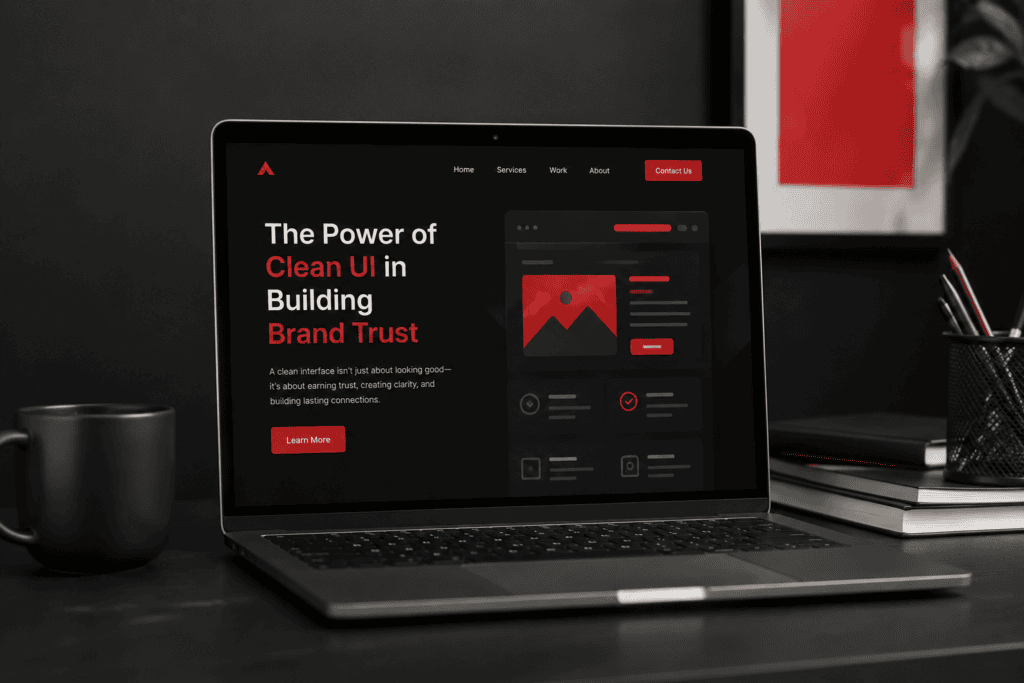
The Power of Clean UI in Building Brand Trust
A clean website is more than something that looks good. It can influence how people perceive your business, how comfortable they feel using your website, and ultimately, whether they trust your brand enough to take the next step. Think about the last time you visited a website for the first time. Maybe you were looking for a service, checking out a business, or considering buying something online. Within a few seconds, you probably had a feeling about the brand. “This business looks professional.” Or perhaps: “Something about this website doesn’t feel right.” You may not have been able to explain exactly why you felt that way, but the design played a major role. That is the power of a clean user interface (UI). In today’s digital-first business environment, your website is often one of the first interactions a potential customer has with your brand. And when that first interaction is confusing, cluttered, outdated, or difficult to use, it can damage trust before you even get the opportunity to explain what your business does. For businesses investing in web development in Lagos, clean UI should therefore be treated as more than a design trend. It should be part of the strategy for building credibility, communicating professionalism, and creating an online experience that customers feel confident using. What Does “Clean UI” Actually Mean? Clean UI does not necessarily mean having a completely minimalist website with lots of empty space and almost no visual elements. Instead, clean UI means that every element on a website has a purpose. The navigation is easy to understand. The typography is readable. The colours work together. The buttons are obvious. The content is properly organised. Images are relevant and high-quality. There is enough whitespace to prevent the page from feeling crowded. Most importantly, visitors don’t have to work hard to figure out what to do next. A clean interface quietly guides users through the website without constantly demanding their attention. And that simplicity matters. When people can easily understand your website, they are more likely to feel that your business is organised, professional, and reliable. Why Does Website Design Affect Brand Trust? Trust is not built only through testimonials, reviews, certifications, or years of experience. It is also built through small signals. Your website’s design is one of those signals. Recent research into website credibility continues to show that design and layout are among the first things people notice when evaluating a website. Clutch’s 2025 research, for example, found that design and layout were the leading factor users noticed when visiting a website for the first time. That makes sense. Imagine walking into a physical business. The reception area is organised. The signs are clear. Everything looks clean and well maintained. The staff know what they are doing. You naturally feel more comfortable. Now imagine walking into another business where everything is disorganised, signs are confusing, information is difficult to find, and nothing looks properly maintained. Even if both businesses offer exactly the same service, you are probably going to trust the first one more. Your website works in much the same way. Good UI creates digital confidence. 7 Ways Clean UI Builds Brand Trust 1. It Creates a Strong First Impression Your website doesn’t get unlimited time to convince visitors that your business is credible. People make quick judgments when they land on a new website. A professional interface immediately communicates attention to detail. This doesn’t mean your website needs expensive animations or complicated effects. In fact, adding too many visual effects can have the opposite effect. A strong first impression can come from simple things: These details might seem small individually, but together they create the overall impression of your brand. 2. It Makes Your Business Look More Professional Your website is an extension of your brand. If your business claims to offer premium services but its website looks outdated, inconsistent, or poorly organised, there is a disconnect. Customers may start asking themselves: “If they don’t pay attention to their website, will they pay attention to my project?” Clean UI helps eliminate that doubt. A consistent visual system, including colours, fonts, buttons, spacing, imagery, and layouts, makes your business feel intentional. It tells visitors that you care about the details. And attention to detail is a powerful trust signal. 3. It Makes Information Easier to Understand One of the biggest mistakes businesses make is trying to put everything on one page. More information doesn’t automatically mean more value. Sometimes, it simply creates more confusion. A clean UI uses visual hierarchy to help visitors understand what matters first. For example, a service page might present information in this order: What you offer → Who it’s for → Benefits → How it works → Proof → Call to action Instead of throwing ten paragraphs, five buttons, three banners, and multiple unrelated sections at the visitor, the interface gives them a logical path to follow. This is particularly important for service businesses. If a potential client cannot quickly understand what you offer, who you serve, and how to contact you, your website is creating unnecessary friction. 4. It Reduces User Frustration A beautiful website that is difficult to use is still a bad website. Clean UI is closely connected to usability. Visitors should be able to answer basic questions without having to hunt around your website: Good UI makes those answers easy to find. For example, your contact button shouldn’t be hidden at the bottom of a long page. Your navigation shouldn’t contain twenty confusing menu items. Your forms shouldn’t ask for unnecessary information. Every unnecessary step creates friction. And friction can cost you customers. 5. It Makes Your Brand More Consistent Imagine seeing a company’s Instagram page with a sophisticated visual identity, then clicking through to a website that uses completely different colours, fonts, images, and messaging. It feels disconnected. Brand consistency helps people recognise and remember your business. Your website should feel like the same brand customers encounter on Instagram, Facebook, LinkedIn, Google, or anywhere