August 2026

how much does SEO cost in Nigeria

How Much Does SEO Cost in Nigeria? A Complete Guide for Small Businesses

If you run a small business in Nigeria, you have probably asked yourself a simple question: how much does SEO cost in Nigeria? The honest answer is that there is no single price. SEO pricing can range from relatively affordable one-time optimization work to several hundred thousand naira per month for an ongoing campaign. The difference usually comes down to the size of your website, how competitive your industry is, how much content you need, your target location, the condition of your website, and the experience of the SEO professional or agency you hire. For a small business, however, SEO does not have to mean spending a huge amount of money every month. A properly planned SEO strategy can help your business appear when potential customers search for your products or services on Google, bringing in relevant visitors without paying for every click. This guide explains SEO costs in Nigeria, what you should expect to pay, what different packages normally include, and how to determine whether an SEO investment makes sense for your business. If you are also considering web development in Lagos, it is important to understand that SEO and website development work closely together. A beautiful website that cannot be found in search results may not generate the business results you expect. Quick Answer: How Much Does SEO Cost in Nigeria? For many Nigerian small and medium-sized businesses, SEO services can cost approximately ₦100,000 to ₦500,000 or more per month, depending on the scope of work and competitiveness of the market. One-time SEO projects, such as technical audits, keyword research, or on-page optimization, can cost considerably less or more depending on the size of the project. A general guide looks like this: SEO Service Typical Cost in Nigeria Suitable For Basic SEO audit ₦30,000 – ₦150,000+ Businesses that want to identify SEO problems One-time SEO project ₦50,000 – ₦500,000+ Specific optimization or website improvements Starter SEO ₦100,000 – ₦200,000/month Small businesses and new websites Growth SEO ₦200,000 – ₦500,000/month Growing businesses targeting more keywords Advanced SEO ₦500,000+/month Competitive industries and larger businesses Enterprise SEO ₦1,000,000+/month Large websites and highly competitive markets These are market-level estimates rather than fixed industry prices. Published Nigerian SEO pricing guides show similarly broad ranges, with cost increasing as competition, content requirements, technical work, and campaign scope increase. For example, Nimah Builds currently offers a Starter Website SEO package at ₦150,000 and a Growth SEO package at ₦250,000, with advanced SEO available based on project requirements. The important thing is not simply finding the cheapest SEO provider. It is finding out what you are actually getting for your money. What Is SEO? SEO stands for Search Engine Optimization. It is the process of improving your website and online presence so that search engines such as Google can better understand your business and show your pages to people searching for relevant information, products, or services. For example, imagine you own a web design company in Lagos. Someone searches: “web development company in Lagos” If your website has been properly optimized and your business is relevant and competitive for that search, one of your pages may appear in the search results. That visibility can lead to website visits, enquiries, phone calls, WhatsApp conversations, bookings, and ultimately customers. Google explains that SEO helps search engines understand your content and helps users discover your website through search. However, there are no guaranteed methods for automatically achieving a particular ranking position. This is why legitimate SEO is not simply about adding keywords to a page. It involves your website’s technical foundation, content, structure, user experience, local presence, authority, and overall relevance. Why Does SEO Cost Money? One reason business owners sometimes question SEO pricing is that Google does not charge businesses to appear in organic search results. That’s true. You do not pay Google simply because your website appears organically. But getting your website into a strong position requires work. Someone has to research the keywords your customers are searching for, analyze competitors, improve website pages, fix technical problems, create useful content, improve internal links, monitor performance, and continuously adjust the strategy. Google itself recommends focusing on making websites useful, accessible, understandable, technically sound, and easy for search engines to crawl and understand. Professional SEO is therefore an investment in the work required to make those improvements. What Does an SEO Package in Nigeria Usually Include? Not every SEO package is the same. This is one of the biggest things Nigerian business owners should understand before paying for SEO. One provider may charge ₦100,000 and another ₦300,000, but that does not necessarily mean the first provider is cheaper. The ₦100,000 package might include basic keyword research and a few on-page changes, while the ₦300,000 package could include technical SEO, content optimization, local SEO, competitor research, reporting, and ongoing strategy. Here are some of the common components of professional SEO. Keyword Research Keyword research identifies the words and phrases potential customers use when searching for your products or services. For a Lagos-based business, this could include searches such as: “web development in Lagos” “website designer in Lagos” “web development company Lagos” “SEO services in Lagos” The goal isn’t to target hundreds of random keywords. The goal is to identify search terms that are relevant to your business and have realistic commercial value. On-Page SEO On-page SEO involves improving individual pages on your website. This can include optimizing page titles, meta descriptions, headings, content, URLs, internal links, image information, and other elements that help search engines and users understand a page. For example, a web development company in Lagos should not have every page competing for the same generic keyword. Instead, individual pages can target specific services and customer needs. A website development page could target website development-related searches, while a website maintenance page could target searches around maintaining business websites. This creates a clearer structure for both visitors and search engines. Technical SEO Technical SEO focuses on the parts of your website that affect crawling, indexing, performance, and usability.

How Much Does SEO Cost in Nigeria? A Complete Guide for Small Businesses Read More »
web development in Lagos

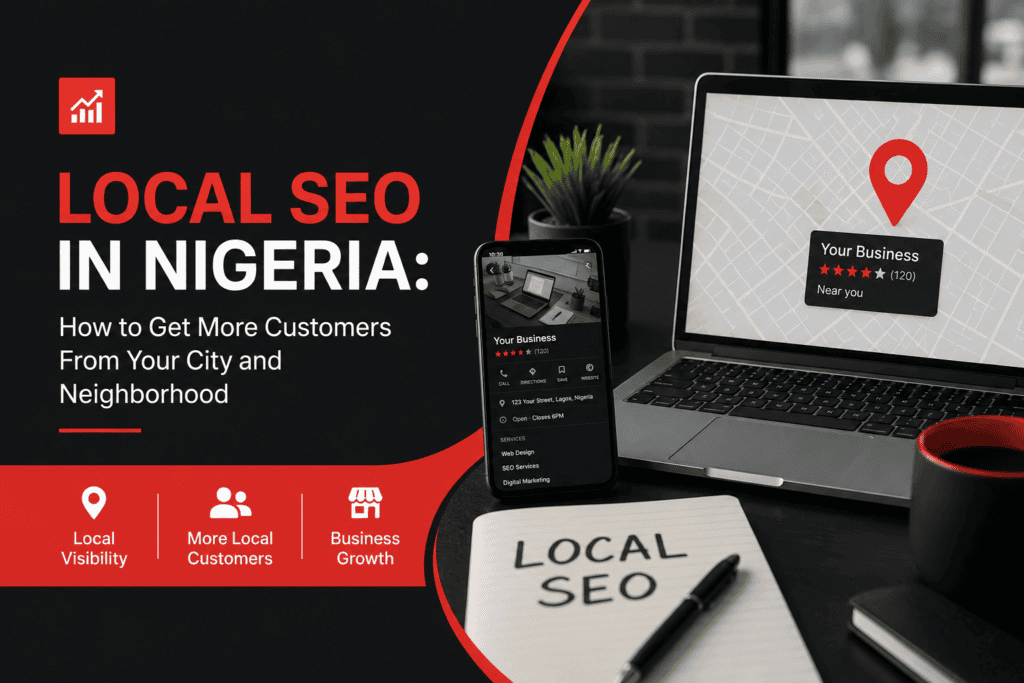
Local SEO in Nigeria: How to Get More Customers From Your City and Neighborhood

Imagine someone in Lekki searching for a plumber. Someone in Ikeja needs a web designer. A business owner in Surulere is looking for an accountant. A customer in Abuja searches for a restaurant nearby. In each situation, the person isn’t looking for a business somewhere in Nigeria. They want a business close to them. That is where local SEO becomes incredibly important. For Nigerian businesses, getting found by people in the right city, area, or neighborhood can mean the difference between receiving a steady stream of enquiries and having a website that gets very little traffic. You may have an excellent product, competitive prices, and a professional team, but if customers searching for your services in your area cannot find you on Google, you are losing potential business to competitors who are easier to discover. This is especially important in competitive markets such as Lagos, where businesses operate across areas such as Lekki, Ikeja, Yaba, Surulere, Victoria Island, Ajah, Maryland, Gbagada, and many others. The good news is that local SEO does not require a huge advertising budget. With the right strategy, your website, Google Business Profile, reviews, local content, and online presence can work together to put your business in front of people who are actively looking for what you offer. What Is Local SEO? Local SEO is the process of optimizing your online presence so that your business becomes more visible when people search for products or services within a specific geographical area. For example, someone might search for: These searches have local intent because the person is looking for a business that serves a particular location. Google uses several signals to determine which local businesses should appear for these searches. Google itself identifies relevance, distance, and prominence as the primary factors behind local rankings. This means your business needs to make it clear what you do, where you operate, and why customers should trust you. Why Local SEO Matters for Nigerian Businesses Traditional advertising can put your business in front of a large number of people, but many of those people may not need your services. Local SEO is different. Someone searching for “web development in Lagos” is already showing an interest in finding a web development service in Lagos. Someone searching for “Nigerian restaurant near me” is actively looking for food. Someone searching for “garage door repair in Dallas” is not casually browsing. They likely have a problem they want solved. This is why local search traffic can be extremely valuable. Instead of trying to convince completely cold audiences that they need your service, local SEO helps you reach people who are already searching for businesses like yours. For small and medium-sized businesses, this can create a much more sustainable source of leads. 1. Start With a Proper Google Business Profile One of the first things a Nigerian business should focus on is its Google Business Profile. Your Google Business Profile can help your business appear in Google Search and Google Maps when people search for relevant local businesses. It should contain accurate and complete information about your company, including your business name, category, services, location, opening hours, contact information, website, photographs, and other relevant details. Google recommends keeping business information complete and accurate because this helps it understand what your business does and match it with relevant local searches. For example, if you run a web development company in Lagos, your profile should clearly communicate that you provide services such as web design, web development, e-commerce development, WordPress development, or other services you genuinely offer. Do not simply create a profile and forget about it. Keep your information updated. Add genuine photographs. Respond to reviews. Update your services when necessary. Your Google Business Profile should be treated as an important part of your digital storefront. 2. Use Location-Based Keywords Naturally One of the biggest mistakes businesses make with local SEO is either ignoring location-based keywords completely or stuffing them into every sentence. Neither approach works well. Instead, think about how your customers actually search. If you operate in Lagos, relevant searches could include: “web development in Lagos” “web design company in Lagos” “website developer in Lagos” “ecommerce website development Lagos” “WordPress developer Lagos” These keywords can be incorporated naturally into your website’s pages, headings, service descriptions, blog articles, page titles, and meta descriptions. For Nimah Builds, for example, the keyword web development in Lagos can naturally support content around website design, business websites, e-commerce stores, website maintenance, SEO-friendly websites, and other relevant services. The goal isn’t to repeat the keyword 50 times. The goal is to make your website genuinely relevant to someone searching for web development services in Lagos. 3. Create Dedicated Location Pages If your business serves multiple cities or areas, location pages can help you communicate that clearly to both customers and search engines. For example, a company serving different parts of Lagos could potentially create useful pages around its actual service areas. A web development company might have content addressing: Web Development in Lagos Web Design in Ikeja Website Development in Lekki E-commerce Website Development in Lagos But there is an important distinction here. Do not create dozens of nearly identical pages simply by changing the name of a neighborhood. That creates thin, repetitive content that offers little value. Instead, every location page should contain genuinely useful information about serving customers in that area. Talk about the types of businesses you serve, the problems customers in that area commonly face, your services, relevant examples, and why customers should choose your business. Good local SEO isn’t about creating more pages. It is about creating better local pages. 4. Make Your Website a Local SEO Asset Your Google Business Profile is important, but your website still plays a major role in your local search strategy. Think of it this way: Your Google Business Profile helps people discover you. Your website helps convince them to choose you. This is why investing in professional web development in Lagos can be much more than simply

Local SEO in Nigeria: How to Get More Customers From Your City and Neighborhood Read More »

web development in Lagos

How to Make Your Website Load Faster: 12 Proven Ways to Improve Website Speed

Have you ever clicked on a website, waited a few seconds, and then thought, “Forget it”? You’re not alone. Most people don’t have the patience to sit around waiting for a website to load, especially when they can simply go back to Google and click on another result. For a business owner, this can be a bigger problem than it seems. A slow website can mean fewer enquiries, fewer sales, frustrated visitors, and a poor first impression of your brand. And if you’re spending money on SEO, social media, or online advertising to bring people to your website, there’s little point in getting visitors there if the website makes them want to leave. The good news is that a slow website can often be improved without starting everything from scratch. There are several practical things you can do to make your website faster, and in this guide, we’ll look at 12 proven ways to improve website speed. If you’re planning to invest in web development in Lagos, these are also things worth discussing with your web developer before your website goes live. Let’s get into it. Why Is Website Speed So Important? Think about your website as your online shop. If someone walks into a physical shop and the doors take 10 seconds to open, the cashier takes another 15 seconds to respond, and every product takes ages to appear, you’d probably walk out. A website isn’t much different. People expect websites to respond quickly. They want to see your services, check your prices, look at your products, read your content, or contact you without fighting with a loading screen. A slow website creates unnecessary friction. And there’s another problem: people may not tell you that your website is slow. They won’t necessarily send you a message saying, “Your website took too long to load.” They’ll just leave. This is why website speed is something every business owner should take seriously. 12 Ways to Make Your Website Load Faster 1. Start With Your Images If I had to check one thing first on a slow website, images would be high on my list. It’s very common for business owners to upload photographs straight from their phones or cameras. Those images can be several megabytes in size. Your website might only display the image at 800 pixels wide, but you’re still asking the visitor’s browser to download the much larger original file. That’s unnecessary. What can you do? Before uploading an image to your website: For example, if your website only needs a 1200px-wide image, there’s usually no reason to upload a 5000px-wide photograph. You can keep the image looking sharp without making your visitors download a massive file. Better images can make a surprisingly big difference to your website speed. 2. Don’t Ignore Your Hosting Sometimes you can optimize everything you possibly can on the website and it still feels slow. That’s when your hosting deserves a closer look. Your hosting company is essentially providing the server that delivers your website to visitors. If that server is slow, overloaded, or doesn’t have enough resources for your website, your visitors are going to feel the difference. This is especially worth considering when you’re paying for professional web development in Lagos. There’s not much point investing in a beautiful website and then putting it on hosting that struggles to handle it. Good hosting should give your website a solid foundation. Look for things such as: And don’t automatically choose the cheapest hosting plan. Sometimes the cheapest option becomes expensive when your website starts having performance problems. 3. Turn On Caching Caching sounds technical, but the basic idea is actually quite simple. Without caching, your server may have to do a lot of the same work every time someone visits your website. With caching, certain files or pages can be stored temporarily and served much faster when someone requests them again. For a WordPress website, proper caching can make a noticeable difference. Depending on your hosting setup, you may have access to: The important thing is to configure caching properly rather than simply installing a caching plugin and assuming the job is done. Some settings can actually cause problems when they’re configured incorrectly. So if you’re not sure what a particular caching setting does, don’t randomly switch everything on. 4. Get Rid of Plugins You Don’t Need This one is especially important if you use WordPress. WordPress plugins are incredibly useful. They allow you to add features without having to build everything from scratch. But there’s a downside. It’s easy to end up with 30, 40, or even more plugins installed because you needed them at different points. Some of them may no longer be doing anything useful. Others may be adding scripts and styles that your website doesn’t really need. Take a few minutes to go through your plugins. Ask yourself: Do I actually need this? If the answer is no, deactivate and remove it. Also watch out for plugins that do basically the same thing. You don’t need three different plugins trying to solve the same problem. A simpler website is usually easier to maintain, troubleshoot, and optimize. 5. Don’t Load Everything at Once Your website doesn’t have to load every single thing immediately. Think about a typical homepage. Maybe it has: If the browser tries to load all of that at the same time, things can get messy. Instead, your website should prioritize the things the visitor needs immediately. For example, if someone opens your homepage, the hero section and main content should take priority. Images much further down the page don’t necessarily need to load immediately. This is where techniques such as lazy loading and deferred loading become useful. 6. Be Careful With Animations Animations can make a website look great. There’s nothing wrong with using them. The problem starts when every section of the website is moving. Text slides in. Images zoom. Buttons bounce. Cards float. Backgrounds move. Then there’s a video playing in the background. At

How to Make Your Website Load Faster: 12 Proven Ways to Improve Website Speed Read More »

web development in Lagos

15 Website Mistakes That Are Costing Nigerian Businesses Customers

A website is supposed to help your business attract customers, build trust, generate enquiries, and make sales. But what happens when the website itself is the reason potential customers leave? For many Nigerian businesses, the problem is not a lack of customers. It is what happens when those customers search for the business online. A potential customer may hear about your company from Instagram, WhatsApp, Google, a referral, or a friend. Before making a decision, they may visit your website to see what you offer and determine whether your business is credible. If the website is slow, confusing, outdated, difficult to use, or impossible to find on Google, that customer may simply move on to a competitor. This is why professional web development in Lagos is about much more than creating an attractive website. A good business website needs to be fast, mobile-friendly, secure, easy to navigate, search-engine friendly, and designed around the needs of real customers. In this guide, we explore 15 common website mistakes that are costing Nigerian businesses customers and what you can do to fix them. 1. Your Website Is Not Mobile-Friendly This is one of the biggest mistakes a Nigerian business can make. Many customers discover and research businesses using smartphones. If your website was designed primarily for desktop computers, visitors using mobile devices may encounter tiny text, oversized images, broken layouts, difficult menus, or buttons that are frustrating to tap. A website does not become genuinely mobile-friendly simply because it technically fits on a smaller screen. The entire experience needs to be considered from a mobile user’s perspective. Customers should be able to read your content, browse your services, contact you, submit a form, or make a purchase comfortably from their phones. When investing in web development in Lagos, mobile-first design should be treated as a necessity rather than an optional feature. 2. Your Website Takes Too Long to Load Nobody wants to stare at a loading screen while trying to find a business. Slow websites are particularly frustrating when customers are browsing on mobile networks or devices with limited bandwidth. Large images, excessive plugins, poor hosting, unoptimized code, and unnecessary scripts can all contribute to poor performance. The consequences go beyond frustration. A slow website can increase abandonment, reduce engagement, and make your business appear less professional. A fast website should load efficiently and give visitors access to the information they need without unnecessary delays. Image compression, efficient code, caching, reliable hosting, and performance optimization can make a significant difference. 3. Your Homepage Does Not Clearly Explain What You Do Imagine someone landing on your homepage for the first time. Can they immediately answer three questions? What do you do? Who do you help? Why should they choose you? If the answer is no, your homepage needs work. Some businesses use vague headlines such as “Welcome to Our Website” or “Providing Quality Solutions Since 2010.” While these statements may sound professional, they do not tell the visitor enough. Your headline and opening section should communicate your value clearly. A customer should not have to scroll through five sections to understand what your business actually offers. Good web development combines design with clear communication. The website should make your business easier to understand, not make visitors work harder. 4. Your Website Looks Outdated Your website is often one of the first places potential customers interact with your brand. If it looks like it was built many years ago and has not been updated since, visitors may unconsciously associate that experience with the quality of your business. An outdated website may have old graphics, inconsistent typography, dated layouts, broken sections, obsolete information, or design elements that no longer work well on modern devices. This does not mean every business needs to redesign its website every year. However, your website should evolve as your business, customers, technology, and brand evolve. A modern website should feel current, intentional, and trustworthy. 5. Your Navigation Is Confusing A customer should not need to investigate your website like a detective. Important pages such as Services, About, Contact, Pricing, Products, or Portfolio should be easy to find. When navigation is confusing, visitors may struggle to find the information they need and eventually leave. Keep your main navigation simple and logical. Use familiar labels rather than creative names that leave users guessing. The goal is not to show visitors everything at once. The goal is to help them find the right information quickly. 6. You Are Hiding Your Contact Information This mistake is surprisingly common. A visitor may be ready to contact your business, but they cannot easily find your phone number, email address, location, WhatsApp option, or enquiry form. That creates unnecessary friction. For many Nigerian businesses, especially service businesses, making contact easy can have a direct effect on enquiries. Your contact details should be visible and accessible from important parts of the website. If WhatsApp is an important communication channel for your customers, consider integrating a clear WhatsApp contact option rather than forcing visitors through a complicated form. Your website should make it easy for an interested customer to say, “I want to talk to this business.” 7. There Is No Clear Call to Action A website can have excellent content and still fail to generate customers. Why? Because it does not tell visitors what to do next. Every important page should have a logical next step. Depending on your business, that could be Get a Quote, Book a Consultation, Call Now, Send a WhatsApp Message, Request a Service, or Shop Now. The mistake is assuming customers will automatically know what to do. They will not. Good web development creates a clear path from interest to action. Instead of simply giving visitors information, your website should guide them towards becoming leads or customers. 8. Your Website Has Poor SEO You can have an excellent website and still receive very little organic traffic if search engines cannot properly understand or rank your pages. Poor SEO can come from several issues,

15 Website Mistakes That Are Costing Nigerian Businesses Customers Read More »

web development in Lagos

Website Maintenance in Nigeria: What It Covers, Why It Matters, and How Much It Costs

Building a website is an important investment for any business, but launching it is only the beginning. Just like a physical office, shop, or vehicle, your website needs regular attention to remain useful, secure, fast, and reliable. A website that was professionally designed six months ago can still develop broken links, outdated software, security vulnerabilities, slow-loading pages, or compatibility problems if nobody maintains it. For businesses investing in web development in Lagos, website maintenance should be considered part of the overall digital strategy, not an optional expense that only becomes important when something goes wrong. In this guide, we’ll explain exactly what website maintenance involves, why it matters for Nigerian businesses, what affects the cost, and how much you should realistically budget for website maintenance in Nigeria in 2026. What Is Website Maintenance? Website maintenance is the ongoing process of checking, updating, securing, improving, and managing a website after it has been launched. It can include everything from updating WordPress and plugins to fixing broken features, monitoring website security, improving page speed, backing up important data, updating business information, and checking whether forms and other functions are working properly. In simple terms, website development creates your website, while website maintenance keeps it working properly. This distinction is important because some business owners assume that once they have paid for a website, there are no further technical responsibilities. In reality, websites depend on software, hosting infrastructure, security systems, third-party integrations, and regularly changing technologies. Without maintenance, even a good website can gradually become unreliable. Why Website Maintenance Matters for Nigerian Businesses Your website is often the first place a potential customer goes when they want to learn about your business. If the website loads slowly, displays errors, has outdated information, or looks broken on mobile devices, visitors may question whether the business itself is reliable. For a business operating in Lagos or anywhere else in Nigeria, this can mean lost enquiries, missed sales, and a weaker online presence. 1. It Keeps Your Website Secure Security is one of the most important reasons to maintain a website. Websites built with platforms such as WordPress rely on a combination of the core software, themes, plugins, hosting, and other technologies. These components receive updates, including security patches. Ignoring updates can leave known vulnerabilities unaddressed. Regular maintenance can involve software updates, malware scanning, security monitoring, backup management, firewall configuration, and other protective measures. A secure website does not guarantee that nothing will ever go wrong, but proper maintenance significantly improves your ability to prevent problems and recover quickly when something does happen. 2. It Prevents Small Problems From Becoming Expensive Problems One of the biggest mistakes a website owner can make is waiting until something breaks before looking for a developer. A small issue such as a broken contact form may go unnoticed for weeks. During that time, potential customers could be trying to contact the business without receiving a response. Likewise, a plugin conflict that causes one section of a website to stop working may eventually affect other parts of the site if it is ignored. Routine maintenance helps identify these problems before they become major repairs. 3. It Helps Maintain Website Speed People expect websites to load quickly, particularly when browsing from mobile devices. As a website grows, it can accumulate large images, unnecessary plugins, outdated scripts, excessive database data, and other elements that affect performance. Website maintenance can include performance checks, image optimization, caching improvements, database cleanup, plugin reviews, and other technical adjustments. A faster website provides a better experience for visitors and can support your broader SEO strategy. 4. It Supports Your SEO Performance SEO is not something you should simply “finish” when your website launches. Search visibility depends on many ongoing factors, including technical health, content quality, website performance, mobile usability, internal linking, indexing, and the overall user experience. For businesses targeting searches such as web development in Lagos, local SEO also needs ongoing attention. A website that regularly publishes useful content, maintains healthy technical performance, keeps business information accurate, and provides a good experience has a stronger foundation for long-term search visibility. Website maintenance does not replace a dedicated SEO campaign, but it helps ensure that technical problems are not undermining your SEO efforts. 5. It Keeps Your Business Information Current Imagine visiting a company’s website and finding an old phone number, outdated service prices, an inactive social media link, or a team member who left the business years ago. It immediately makes the business look neglected. Regular website maintenance gives you an opportunity to update service descriptions, contact details, business hours, team information, images, testimonials, prices, products, blog posts, and other important information. Your website should reflect the business customers can actually interact with today. What Does Website Maintenance Cover? The exact scope depends on the website and the maintenance package you choose. However, professional website maintenance in Nigeria commonly includes several important areas. Software and Plugin Updates If your website uses WordPress or another content management system, the core software, themes, and plugins may require regular updates. Updates can introduce new features, improve compatibility, fix bugs, and address security issues. However, blindly clicking “update everything” is not always the best approach. A professional maintenance process should consider compatibility and, where appropriate, create a backup or test changes before applying them to a live website. Website Backups Backups provide a safety net. If your website is hacked, accidentally damaged, affected by a faulty update, or compromised by a hosting problem, a recent backup can make recovery considerably easier. A good maintenance strategy should consider how frequently backups are created, where they are stored, how long they are retained, and whether restoration actually works. A backup that has never been tested is not as reassuring as many website owners think. Security Monitoring Security maintenance may include malware scanning, vulnerability checks, login protection, firewall management, suspicious activity monitoring, and security updates. The level of protection required depends on the type of website. An online store processing customer orders requires

Website Maintenance in Nigeria: What It Covers, Why It Matters, and How Much It Costs Read More »

web development in Lagos

How to Get Your Business on Google: A Beginner’s Guide for Nigerian Businesses

If you run a business in Nigeria and people can’t find you on Google, you may be missing customers who are already searching for what you sell. Think about it. Someone in Lagos searches for “best fashion designer near me,” “web developer in Lagos,” “Nigerian restaurant near me,” or “accountant in Lekki.” If your business doesn’t appear, another business gets the opportunity to win that customer. The good news? Getting your business on Google does not have to be complicated or expensive. You don’t need to be an SEO expert, spend thousands of naira on advertising, or have a massive website before you can start building your presence on Google. In this beginner-friendly guide, you’ll learn how to get your Nigerian business on Google, how Google Business Profile works, how to get your website indexed, and why having a properly built website can make a major difference to your online visibility. Why Should Nigerian Businesses Be on Google? Google is one of the first places people go when they need a product, service, company, restaurant, professional, or local business. Your potential customers may already be searching for businesses like yours without knowing your name. For example: If your business has little or no online presence, Google has fewer signals to understand who you are, what you offer, and where you serve customers. Getting visible on Google can help you: And unlike social media, where your content can quickly disappear from someone’s feed, your website and Google presence can continue attracting potential customers through search. Step 1: Create a Professional Business Website Before worrying about rankings, make sure your business has a proper online home. Your website is the foundation of your digital presence. A Facebook page, Instagram account, WhatsApp number, or TikTok profile can be useful, but you don’t fully control those platforms. Your website gives you a place where you control your branding, content, services, contact information, and customer journey. A professional website should clearly communicate: For example, if you provide web development in Lagos, your website should make that immediately clear instead of forcing visitors to guess what you do. Your homepage could naturally communicate something like: “Professional Web Development in Lagos for Small Businesses and Startups.” That is much clearer for both potential customers and search engines. Google’s SEO documentation emphasizes making websites easy for search engines to crawl, understand, and index while also creating useful experiences for people. Your website should also be: This is where professional web development in Lagos can become more than just making a website look attractive. The technical foundation of your website can influence how easily users and search engines interact with it. Step 2: Create a Google Business Profile For many Nigerian businesses, this is one of the most important steps. A Google Business Profile allows eligible businesses to manage how they appear on Google Search and Google Maps at no charge. You can add information such as your business name, hours, phone number, website, location or service area, photos, and more. For example, imagine you own a catering company in Lagos. Someone searches: “Catering services in Lagos.” A properly set-up Business Profile can help your business appear in Google’s local results and Maps, giving the searcher an easy way to discover your business. What can you add to your Google Business Profile? Depending on your business and eligibility, you can provide: Google also allows businesses to interact with customers through their profiles, including responding to reviews and sharing photos and updates. Important: Not every online business is eligible Google Business Profiles are intended for businesses that interact with customers in person, including storefront businesses and service-area businesses. For example, a plumber who travels to customers can qualify even without a traditional storefront. An online-only business that never meets customers in person generally isn’t eligible for a Business Profile. So don’t create a fake location simply because you want to appear on Google Maps. Step 3: Add or Claim Your Business on Google If your business doesn’t already have a profile, you can add it. If Google already has an unclaimed listing for your business, you may be able to claim it instead. Google’s current process allows eligible businesses to add or claim their Business Profile and then complete the verification process. You’ll generally need to: Google determines which verification methods are available for a particular business. Depending on the circumstances, verification may involve methods such as phone, text, or video verification. Don’t panic if Google doesn’t give you the verification option you expected. The available methods can vary based on factors such as your business type, region, and other information associated with the profile. Step 4: Make Your Google Business Profile Complete Creating the profile is only the beginning. A half-completed profile doesn’t give potential customers much confidence. Imagine searching for two businesses. Business A has: Business nameNo photosNo websiteNo descriptionNo opening hoursNo reviews Business B has: Business nameProfessional photosWebsiteAccurate opening hoursServicesLocation/service areaCustomer reviewsRegular updates Which one would you be more comfortable contacting? Exactly. Complete as much relevant information as possible Use your real business information and keep it consistent. Your business name, phone number, website, location, service areas, and operating hours should be accurate. Don’t stuff your business name with keywords. For example, if your actual brand is NimahBuilds, don’t turn it into something unnatural like: “NimahBuilds Best Cheap Web Development in Lagos Website Designers SEO Company” That isn’t professional. Use your actual business name and describe your services naturally in the appropriate sections. Step 5: Add High-Quality Business Photos People want to know what they’re dealing with before contacting a business. Photos can help make your business feel more legitimate and familiar. Depending on your business, consider adding: For example, a restaurant could showcase its food and dining environment. A construction company could show completed projects. A web development agency could showcase website projects and professional team or workspace images. Don’t upload random stock photos simply to fill space. Your images should represent your actual business.

How to Get Your Business on Google: A Beginner’s Guide for Nigerian Businesses Read More »

web development in Lagos

Website vs Instagram: Why Your Business Still Needs a Professional Website

If your business is already getting customers from Instagram, you may have asked yourself a very reasonable question: “Why should I spend money on a website when Instagram is already working?” It is a fair question. Instagram is powerful. It can help you showcase your products, build a community, connect with potential customers and generate sales without requiring a complicated setup. For many Nigerian businesses, Instagram has become one of the most important marketing channels available. But there is one important distinction: Instagram is a marketing platform. Your website is your business’s digital home. They are not competitors, and you do not necessarily have to choose between them. In fact, the strongest online presence often comes from using Instagram to attract attention and a professional website to build trust, provide information and convert that attention into enquiries and sales. For businesses investing in web development in Lagos, understanding this difference can help you make a much smarter digital investment. Instagram Is Great, But It Was Never Designed to Be Your Entire Business Instagram is excellent at helping people discover brands. A potential customer might see your Reel, visit your profile, scroll through your posts, check your Stories and eventually send you a DM. That journey can work extremely well. But Instagram has limitations. Your content competes with thousands of other posts. Your reach depends partly on an algorithm you do not control. Your profile has a fixed structure, and important business information can easily get buried beneath newer posts. Most importantly, you do not own Instagram. Meta controls the platform, its features, its algorithms and its rules. That does not mean you should stop using Instagram. Quite the opposite. It means you should avoid making a third-party platform the only place where your business exists online. Your website gives you something Instagram cannot: a digital property that belongs to your business. Website vs Instagram: What’s the Real Difference? Think of Instagram as the busy street where people discover your business. Think of your website as the shop they walk into. Instagram can get people interested. Your website can give them the information they need to make a decision. Instagram Professional Website Excellent for discovery Excellent for search and discovery Great for visual content Great for detailed information Builds social engagement Builds credibility and authority Dependent on platform algorithms Owned by your business Limited page structure Fully customizable Content can quickly disappear in the feed Important information remains accessible Strong for community building Strong for lead generation and conversions Primarily social-driven Can attract traffic from Google, social media and other channels The smartest approach isn’t website vs Instagram. It is website + Instagram. 1. A Website Makes Your Business Look More Established Let’s be honest. When someone discovers a business on Instagram, one of the first things they may do is search for the business name on Google. And what happens if they find a professional website? It immediately gives them another reason to take the business seriously. A well-designed website can showcase: Instead of asking customers to scroll through dozens of Instagram posts to understand what you offer, you can give them a clear, organized experience. That matters when you are trying to turn a curious visitor into a paying customer. 2. Your Website Helps You Get Found on Google This is one of the biggest differences between having a website and relying entirely on Instagram. People don’t only discover businesses through social media. They also search Google. Someone might search: If you have a properly optimized website, you have an opportunity to appear when potential customers are actively searching for what you offer. Google explains that establishing your official website and business information can help users recognize your business and find information about it in Search and other Google surfaces. This is where SEO and web development in Lagos become especially valuable. A website should not simply look good. It should have a strong technical foundation, useful content, clear page structure, good performance and information that helps search engines understand your business. Instagram can help you reach people who are scrolling. A search-optimized website can help you reach people who are actively looking. 3. Your Website Builds Trust Before You Speak to a Customer Imagine two businesses offer the exact same service. Business A has an Instagram page with beautiful photos and a WhatsApp number. Business B has the same Instagram presence, but also has a professional website explaining its services, showcasing previous work, answering common questions and providing several ways to get in touch. Which one feels more established? For many customers, the second business will naturally feel more credible. A website doesn’t magically make a business trustworthy. Your service, reviews, communication and results still matter. But a professional website gives potential customers more information to evaluate you. And that can reduce hesitation. 4. You Control the Experience Instagram gives every business essentially the same basic profile structure. Your profile picture. Your bio. Your grid. Your links. Your Stories. Your Reels. Your Highlights. That structure works, but your ability to customize the customer journey is limited. With a website, you control the experience. You decide what customers see first. You can create a homepage that immediately communicates your value. You can create dedicated service pages. You can build landing pages for advertising campaigns. You can create product categories. You can add booking forms. You can integrate WhatsApp. You can collect enquiries. You can publish helpful articles. You can even create an online store. This flexibility is one of the major reasons professional web development in Lagos continues to matter for growing businesses. 5. Your Website Can Work 24/7 Your Instagram page can answer some questions, but customers often still need to send a DM. “What services do you offer?” “How much does this cost?” “Where are you located?” “Do you deliver?” “Can I book?” “What are your opening hours?” “Do you have examples of previous work?” A well-structured website can answer many of these questions before the

Website vs Instagram: Why Your Business Still Needs a Professional Website Read More »

web development in Lagos

SEO for Small Businesses in Nigeria: A Practical Guide to Getting Found on Google

If you run a small business in Nigeria, getting customers online can sometimes feel like shouting in a crowded market and hoping someone hears you. You may have a good product, excellent service, an active WhatsApp account, and even a professionally designed website. But if potential customers cannot find you when they search Google, you are still missing opportunities. This is where Search Engine Optimization (SEO) comes in. SEO helps your website appear when people search for products, services, and answers related to your business. For a small business, that can mean more website visitors, more enquiries, more phone calls, more WhatsApp conversations, and ultimately more customers. The good news is that you do not need a huge marketing budget to start. With the right strategy, a Nigerian small business can build a strong presence on Google by focusing on the things that actually matter: useful content, a technically sound website, relevant keywords, local visibility, and a consistent online presence. In this practical guide, we will break down SEO for small businesses in Nigeria, including what to do first, what mistakes to avoid, and how your website can become a reliable source of customers. What Is SEO and Why Does It Matter for Nigerian Small Businesses? Search Engine Optimization is the process of improving your website and online presence so search engines can better understand your business and connect your pages with relevant searches. For example, imagine you own a fashion brand in Lagos. Someone searches: “best women’s clothing store in Lagos” Or perhaps they search: “custom dresses in Lekki” If your website is properly optimized, Google has a better chance of understanding that your business is relevant to those searches. SEO is different from Google Ads. With advertising, you pay to appear in sponsored positions. With organic SEO, you work on your website and online presence so your business can earn visibility in Google’s unpaid search results. Google itself notes that there is no payment that guarantees a higher organic ranking. For small businesses, this distinction matters. You are not simply trying to get website traffic. You want to attract the right people who are already searching for what you offer. 1. Start With the Right Keywords One of the biggest SEO mistakes small businesses make is choosing keywords based on what they call their service rather than what their customers actually search for. Your customers might not search for: “Premium integrated business solutions.” They might search for: “accountant in Lagos” “website designer in Lagos” “catering services in Abuja” “best Nigerian food near me” “real estate company in Lekki” The difference is important. Think Like Your Customer Before creating content, make a list of the questions and phrases your potential customers might type into Google. Consider: You can then group your keywords into three broad categories: Transactional keywords These usually indicate that someone is ready to take action. Examples: Informational keywords These indicate that someone is looking for information. Examples: Local keywords These combine a service or product with a location. Examples: For small businesses, local and transactional keywords can be particularly valuable because they often connect your business with people who are closer to making a purchase. 2. Optimize Your Website Around Search Intent Finding keywords is only the beginning. The next question is: What does the person actually want when they search that keyword? This is called search intent. Suppose someone searches: “web development in Lagos.” They may be looking for a company that can build their website. A page targeting that keyword should therefore explain the service, show what the business offers, demonstrate credibility, answer common questions, and give visitors an obvious way to get started. It should not simply repeat “web development in Lagos” 30 times. Google’s current SEO guidance emphasizes creating helpful, reliable, people-first content rather than content written primarily to manipulate search rankings. The goal should always be: Help the visitor first. Optimize for search engines second. 3. Create Dedicated Pages for Your Main Services A common problem with small business websites is putting everything on one page. For example: Home → About → Contact And then every service is mentioned somewhere on the homepage. That may not give Google enough information to properly understand the different things your business offers. Instead, consider creating dedicated service pages. For example, a web agency might have: Each page can target a specific service and explain: This also gives potential customers a much better experience. At NimahBuilds, for example, web development, website maintenance, and SEO are presented as distinct services rather than treating everything as one generic offering. That structure makes sense for both users and search engines. 4. Make Your Website Fast, Mobile-Friendly and Easy to Use A beautiful website that takes forever to load is still a bad website. This is particularly important for businesses targeting customers in Nigeria, where visitors may access websites using mobile devices and varying network conditions. Your website should: Google’s developer guidance specifically recommends websites that are secure, fast, accessible, and functional across devices. And remember: your website is not just an SEO tool. It is where the customer decides whether your business looks trustworthy enough to contact. 5. Optimize Your Page Titles and Meta Descriptions When someone searches Google, the title of your page is one of the first things they see. Instead of: Home | My Business You could have something more descriptive, such as: Web Development in Lagos | Professional Business Websites | NimahBuilds Your title should clearly communicate what the page is about. Meta descriptions are also useful because they can help explain what a searcher can expect from the page. For example: Looking for professional web development in Lagos? NimahBuilds creates fast, modern websites designed to help Nigerian businesses attract customers and grow online. Google recommends unique, descriptive titles and useful page descriptions because they help users understand what a page offers. Avoid stuffing keywords into titles. Write for humans. 6. Use Your Location Naturally If your business serves a specific Nigerian city,

SEO for Small Businesses in Nigeria: A Practical Guide to Getting Found on Google Read More »

web development in Lagos

10 Signs Your Business Website Needs a Redesign

Your website may be one of your most valuable business assets, or one of the biggest reasons potential customers leave without contacting you. Think about it: when someone discovers your business through Google, Instagram, Facebook, a referral, or an online advert, your website is often the next place they go. Within seconds, they form an impression of your brand, decide whether they trust you, and determine whether they want to take the next step. And that is exactly why an outdated website can quietly cost your business customers. A website doesn’t necessarily need a redesign simply because it looks old. Sometimes, the problem is deeper: poor performance, confusing navigation, weak messaging, outdated technology, bad mobile experience, or a lack of clear conversion paths. If your website suffers from several of the issues below, it may be time to consider a professional redesign. What Does a Website Redesign Actually Mean? A website redesign is more than changing colours, fonts, images, or adding a new homepage. A proper redesign looks at the entire website experience, from visual design and structure to speed, mobile responsiveness, SEO, content, security, usability, and conversions. For businesses investing in web development in Lagos, a redesign can be an opportunity to create a website that not only looks professional but also works harder to attract visitors, build trust, and generate enquiries. Here are 10 signs that your business website may be ready for one. 1. Your Website Looks Outdated First impressions matter. If your website looks like it was designed several years ago, visitors may subconsciously assume that your business is also behind the times. Common signs of an outdated website include: Your website doesn’t need to follow every design trend. In fact, chasing trends can make a website age even faster. Instead, your design should feel modern, intentional, professional, and appropriate for your industry. A redesign gives you the opportunity to create a cleaner visual identity that reflects the quality of your actual business. 2. Your Website Is Difficult to Use on Mobile This is a major warning sign. If visitors have to pinch, zoom, scroll sideways, or struggle to click buttons when using your website on a smartphone, something needs to change. Google uses the mobile version of websites for indexing and ranking, making mobile-friendly design particularly important for businesses that want to compete in search. A modern business website should adapt naturally to: Menus should be easy to access, text should be readable, buttons should be easy to tap, and important information should remain accessible without unnecessary scrolling. If your website looks great on a laptop but frustrating on a phone, it isn’t doing its job properly. 3. Your Website Takes Too Long to Load Nobody likes waiting for a slow website. A visitor may be interested in your services, click your website, and then leave simply because the page takes too long to appear. Slow websites can be caused by many things, including: Website performance is also connected to user experience and search visibility. Google’s Core Web Vitals focus on loading performance, responsiveness, and visual stability, with recommended targets including an LCP of 2.5 seconds or less, INP below 200 milliseconds, and CLS below 0.1. A redesign can therefore be an opportunity to rebuild your website with performance in mind instead of simply adding more features to an already bloated site. 4. Visitors Don’t Know What Your Business Actually Does This problem is surprisingly common. You may understand your business perfectly because you work with it every day. Your website visitors don’t have that advantage. If someone lands on your homepage and has to ask: “What exactly does this company do?” your messaging needs work. Your homepage should quickly communicate: What you do + who you help + why you’re different + what the visitor should do next. For example, instead of a vague headline like: “Welcome to the future of excellence.” A clearer message could be: Professional Web Design and SEO Services for Businesses in Lagos The second version immediately tells the visitor what the business offers and who it serves. A redesign should therefore look beyond aesthetics and improve your website’s messaging and positioning. 5. Your Website Doesn’t Generate Enquiries or Sales Getting visitors is only part of the equation. The bigger question is: What happens after they arrive? If your website receives traffic but very few people contact you, request a quote, book a consultation, make a purchase, or complete another important action, your website may have a conversion problem. Look for issues such as: A good website should guide visitors toward the next logical step. That might be Get a Quote, Book a Consultation, Shop Now, Call Us, Send a WhatsApp Message, or Request a Free Consultation. Your redesign should be built around the actions you want visitors to take. 6. Your Website Is Difficult to Update Imagine needing to change a phone number, add a new service, publish a blog post, update a product, or change an image, and having to contact a developer every single time. That isn’t ideal. Modern websites should make routine content management reasonably straightforward for business owners and their teams. If your website relies on outdated technology, has an unnecessarily complicated backend, or contains years of accumulated technical problems, a redesign can simplify the system. For businesses using WordPress, for example, a properly structured website can make it much easier to manage pages, services, blog content, products, forms, and other important information. The goal isn’t simply to make the website easier for developers. It should also make the website easier for you to manage. 7. Your Website Is Not Optimised for Search Engines A beautiful website that nobody can find isn’t doing enough for your business. If your website doesn’t appear when potential customers search for services you offer, you may have an SEO problem. Some warning signs include: A redesign provides an opportunity to rebuild your website with SEO from the beginning rather than treating search optimisation as an afterthought. This is

10 Signs Your Business Website Needs a Redesign Read More »